
Outbound lead generation usually takes two to three weeks to set up, produces its first replies within the first month or so of sending, and needs about three months before you can judge it properly. First meetings follow the first interested replies, as long as someone answers them quickly. Pipeline builds through the second and third months as the targeting and messages are refined. Closed deals come after that, on your normal sales cycle, so a business that usually takes six months to win a client shouldn't expect signed work in six weeks.
The timeline varies because each stage depends on something different. Setup depends on approvals and the sending setup. Replies depend on who you target and whether your offer gives them a reason to answer. Meetings, pipeline and closed deals depend mostly on what happens after someone replies: how fast you respond, how well the conversation is handed over, whether "not right now" gets a follow-up date, and whether your CRM shows which conversations are moving. That last part is where a lot of the time is won or lost.
What are the stages, and how long does each one take?
Here's the order things happen in, with timing only where we can stand behind it. These are the stages for a managed cold email or hybrid campaign, which is what we run for Australian B2B businesses.
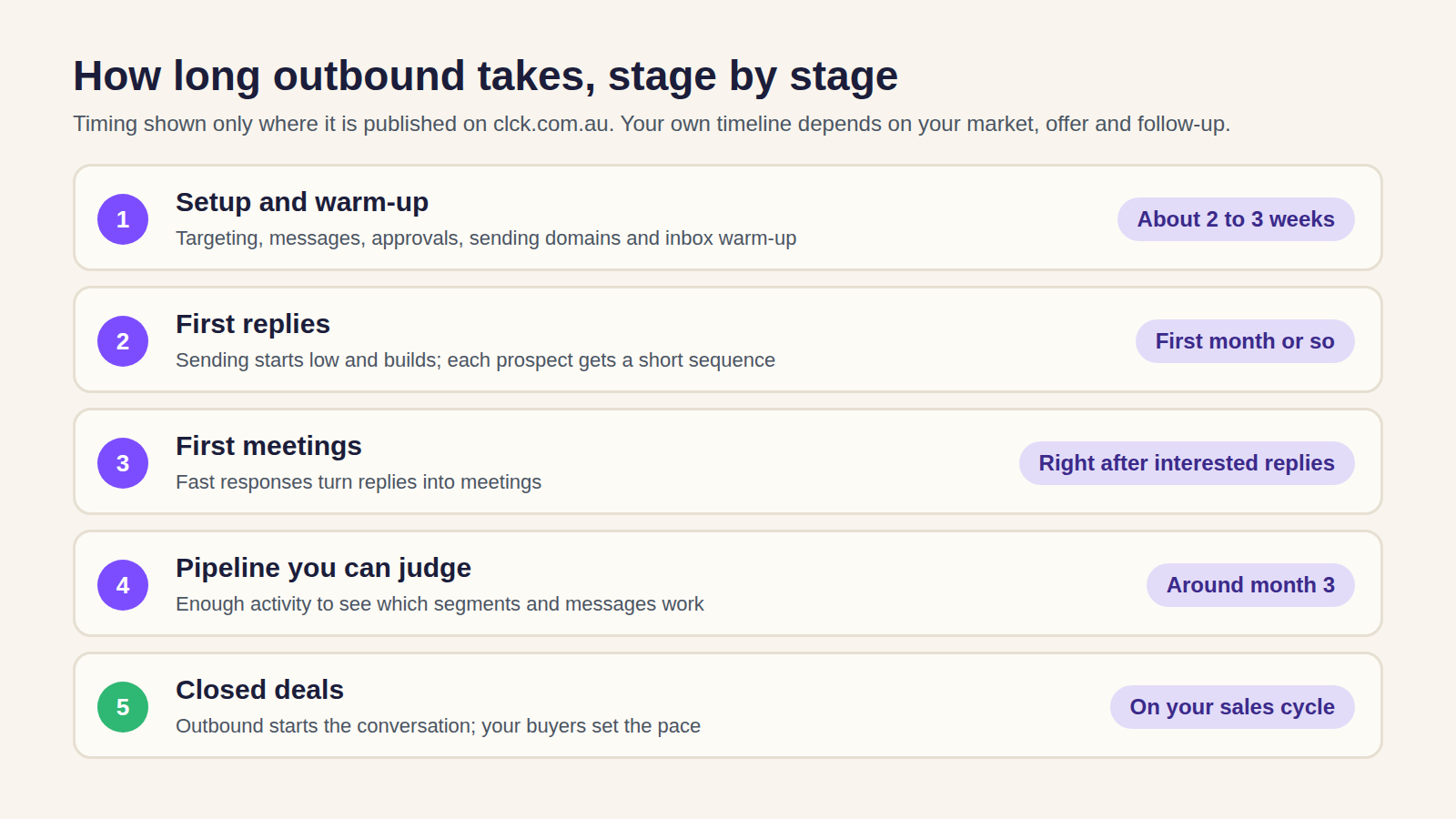
- Setup and warm-up: about two to three weeks. For our managed outbound programme, setup and warm-up typically take around 10 to 15 business days. That covers agreeing who to target, writing and approving the messages, and setting up separate sending domains and inboxes, then warming them gradually so your main domain doesn't carry the campaign.
- First sends and first replies: the first month or so. Sending starts at a low volume and builds. Each prospect gets a short sequence of messages rather than one, so someone first contacted in week three may not reply until week five or six. Early replies often arrive in the first month, but the first month is mostly ramp.
- First meetings: as soon as interested replies are handled. A meeting is only ever one step behind an interested reply. If replies are answered the same day, the first meetings can land in the first few weeks of sending. If they wait in an inbox, they slip, or don't happen at all.
- Pipeline you can judge: around month three. The first few months are mostly list testing, inbox care, learning which messages land and handling replies. By about the three-month mark there's enough activity to see which segments and messages are producing real opportunities.
- Closed deals: on your sales cycle. Outbound can start a conversation, but it doesn't change how long your buyers take to decide. A small, quick purchase can close within the campaign's first weeks. A large contract with several decision-makers takes as long as it usually takes.
If you're comparing an outside team with hiring a sales development representative, our guide to outsourcing lead generation or hiring an SDR sets the two timelines side by side. If you run a recruitment agency, what to expect in the first 90 days of outsourced business development walks through each month for an agency.
Why does the first month often look quiet?
Because most of what happens in month one is invisible to you. The list is being built and checked, the inboxes are warming, and the messages going out are the first in each sequence. Many people don't reply to a first message. Some reply to the second or third, and some reply weeks later when the timing suits them.
A quiet first month isn't a reason to worry, provided the setup is right. What you can check at day 30 is whether sending is live, whether the companies on the list are ones you'd actually want as clients, and whether everyone knows who takes an interested reply. If those are in place, judge the numbers later.
What changes how quickly outbound produces results?
Two campaigns that start on the same day can be months apart in results. These are the usual reasons.
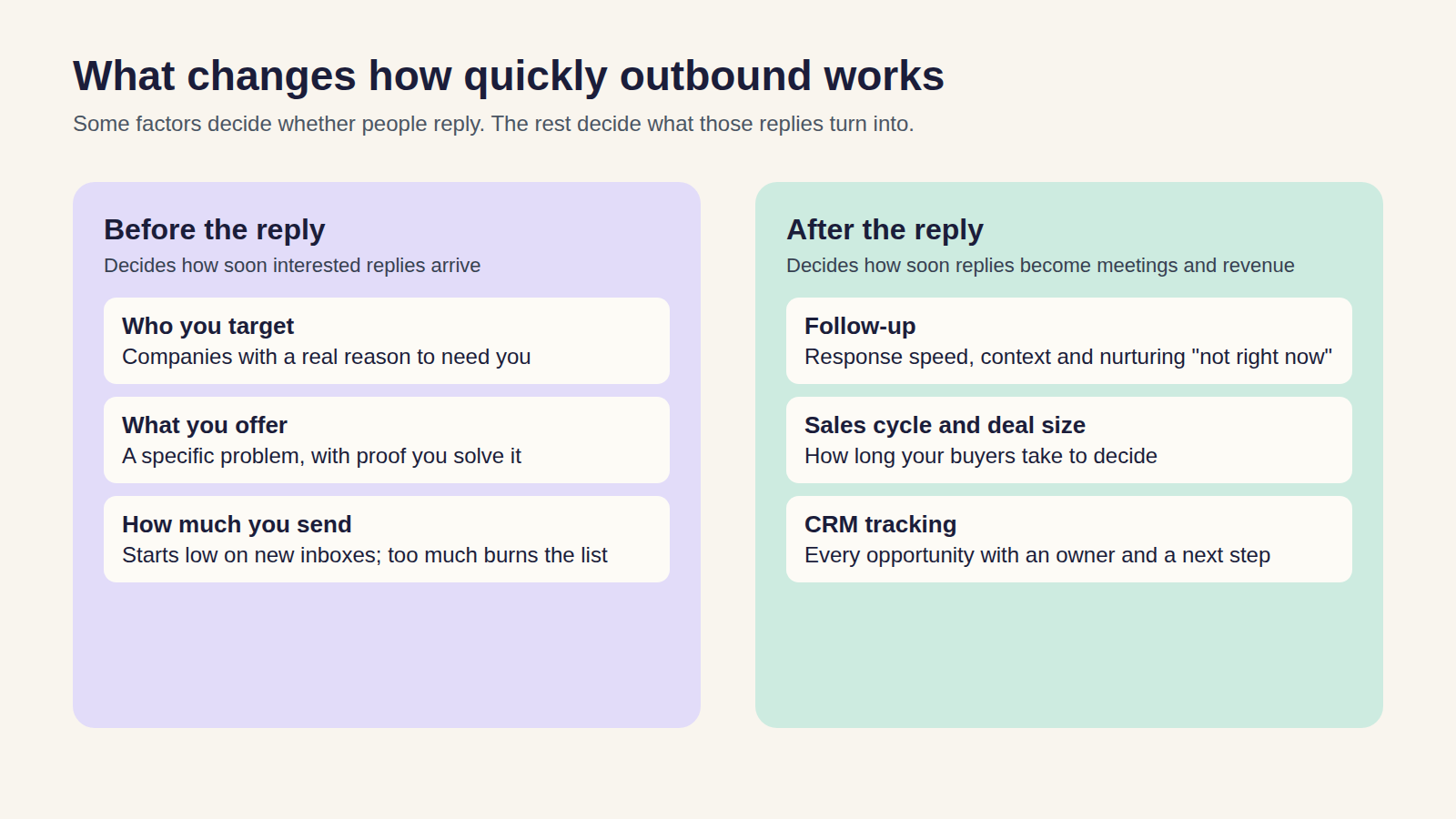
Who you target
A tight list of companies with a real reason to need what you sell gets replies sooner than a loose list built from database filters. Size the market honestly too. If only a few hundred companies genuinely fit, the plan should be built around them, with more research on each, rather than a sending target that runs through them in a month. Our article on why outbound lead generation stops scaling covers what happens when volume outruns the market.
What you're offering
The buyer has to see a reason to reply. A specific problem you solve, for a specific type of company, with proof that you've solved it before, gets answered sooner than a general introduction to your services. When replies are slow, the offer is often the first thing to look at, ahead of the copy or the tools.
How much you send
More volume brings replies sooner, up to a point. Past that point it burns through your best-fit accounts and loosens the targeting. Sending also has to start low on new inboxes, which is part of why the first weeks are slower.
Your sales cycle and deal size
This sets the pace once the conversation has started. A business selling a one-off project to a single owner can go from reply to signed work in days. A business selling a multi-year contract to a committee can't, however good the campaign is. Higher-value sales tend to take longer to decide, and they also give a campaign more room to pay its way.
What happens after the reply
This is the factor most businesses underestimate, so it gets its own section.
Why does follow-up decide so much of the timeline?
Lead generation doesn't stop at the reply. An interested reply is the start of a sales process, and how well that process runs decides whether it becomes a meeting this week, a proposal next month, or nothing.
Here's where we see the time go:
- Slow responses. An interested reply that waits two days often goes cold. Set a response time your team can actually meet, and check it.
- Handovers without context. The person taking the call should know what the prospect was sent, what they replied and why they might care. Otherwise the first meeting is spent catching up.
- Every reply gets a booking link. Some replies need an answer to a question first. Pushing everyone to a calendar can book meetings with people who were never going to buy. We cover how to avoid that in why outbound lead generation books unqualified meetings.
- "Not right now" goes nowhere. Plenty of good prospects reply with "maybe later". Without a follow-up date and a reason to get back in touch, that future pipeline disappears. What to send a lead who says "not ready yet" covers what to send them.
- No record of what happened next. If meetings, proposals and outcomes aren't tracked in a CRM, nobody can tell which segment or message is producing clients, so the campaign can't be refined. Any CRM works, HubSpot or another, as long as each opportunity has an owner, a stage and a next step. If your deal stages don't match how you actually sell, map your sales process before you set up pipeline stages.
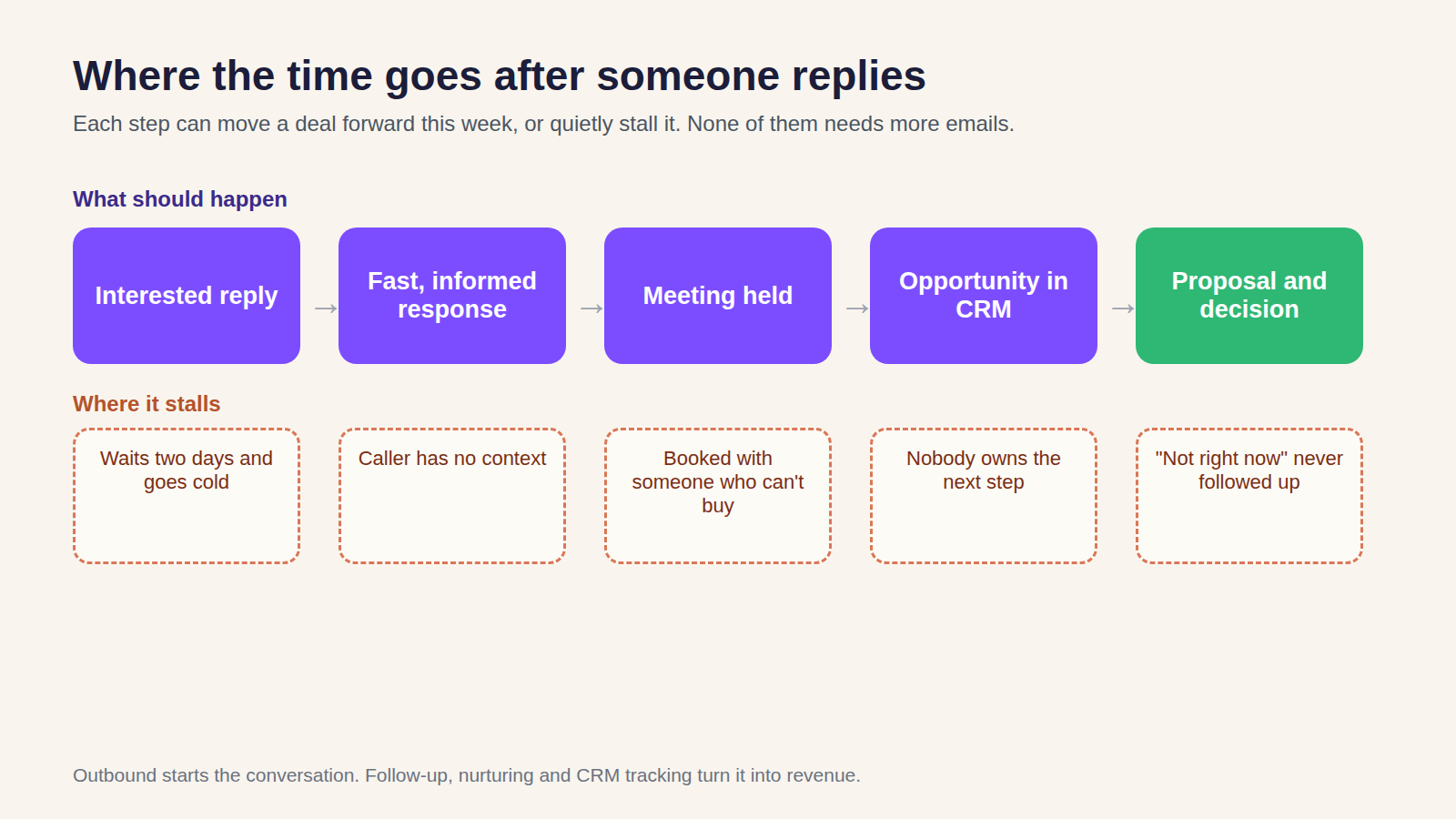
This is why we treat outbound as part of your sales system rather than a separate activity. The targeting and messages get people talking. The follow-up, nurturing and CRM tracking are what turn those conversations into revenue, and they're usually where a slow campaign can be sped up without sending a single extra email.
What do real campaign timelines look like?
Results vary a lot by offer and market. Here are some historical examples from campaigns we've run, each published on our website. They're separate campaigns, not averages or forecasts, and they show how differently "results" can look.
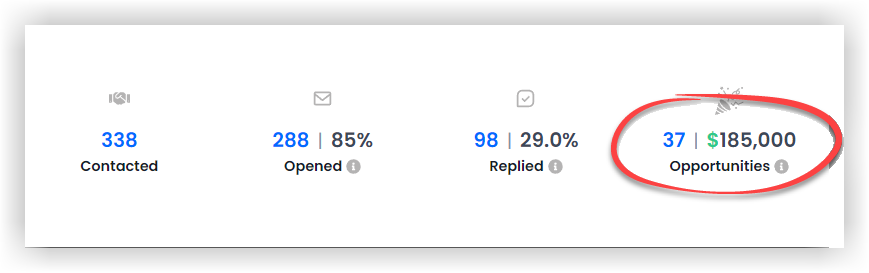
- Four new clients in 40 days, pipeline in under 60. A lead-management software business contacted 338 targeted people. The campaign received 98 replies, 37 of them interested, which led to 15 booked meetings and four new clients within the first 40 days. The wider campaign recorded $185,000 in pipeline in under 60 days. (From our B2B lead generation page.)
- Six confirmed proposals in 15 days. One campaign turned 18 interested prospects into six confirmed proposals in 15 days. (From our cold email page.)
- Three new clients in two months. A digital agency closed three new clients within the first two months. (From our B2B lead generation page.)
- Fifteen new clients over three months. A business directory closed 15 new clients over three months of outreach, a different offer and buying decision with results built over a longer period. (From our B2B lead generation page.)
One client, Mary B., Managing Director of Calculated Solutions, put it this way: "Within the first month of our first campaign, I started securing clients." That's a fast start, and not one we'd promise. Pipeline is potential business, not revenue received, and your offer, market and sales process will shape your own timeline.
When should you judge an outbound campaign?
Judge the setup at the end of the first month and the results at around three months.
At one month, check the foundations: sending is live, the list is right, the messages are ones you'd stand behind, and interested replies are reaching the right person quickly.
At three months, count what matters to the business, in order:
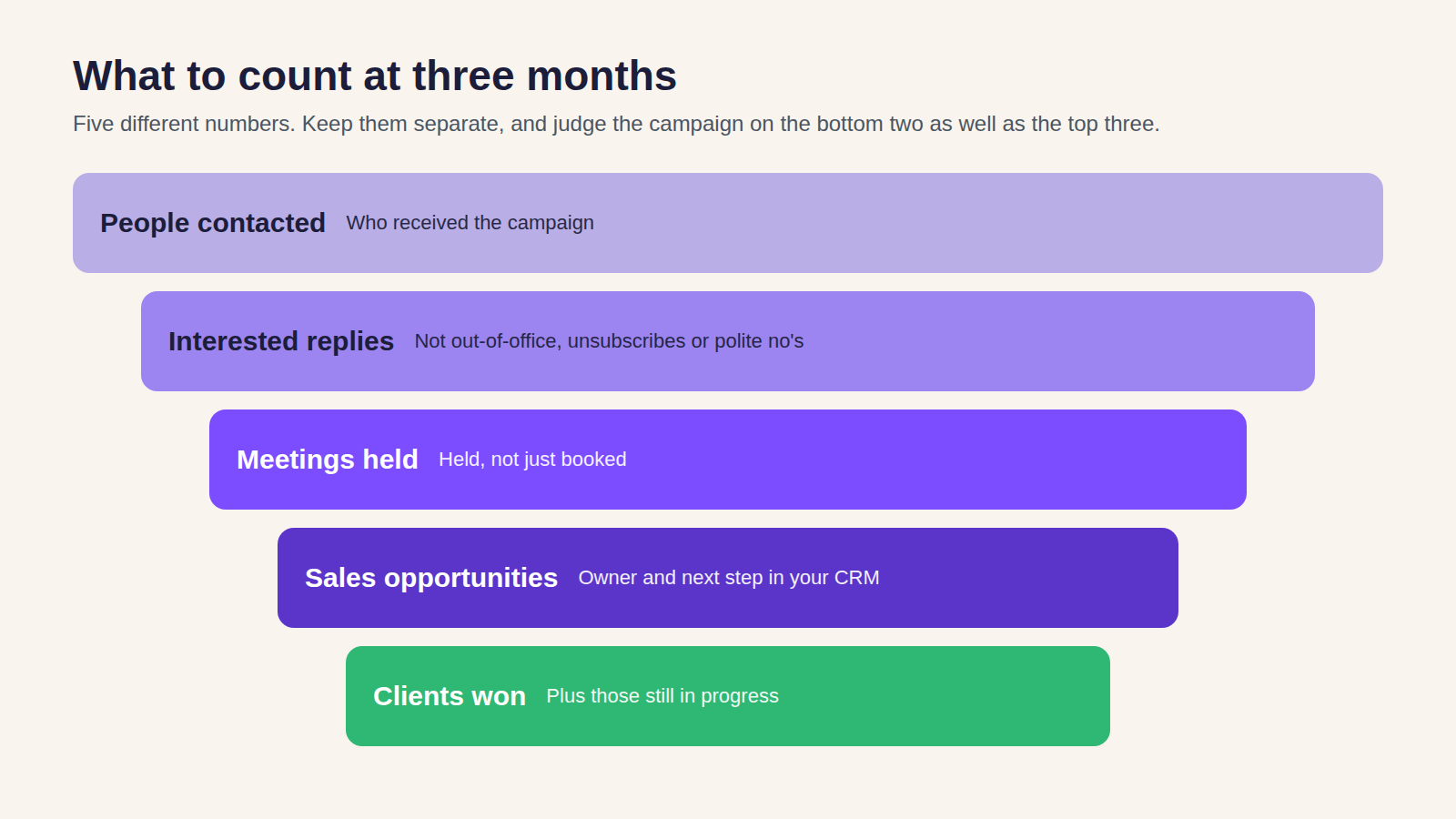
- People contacted.
- Interested replies, kept separate from out-of-office replies, unsubscribes and polite no's.
- Meetings held, not just booked.
- Sales opportunities, with an owner and a next step in your CRM.
- Clients won, and those still in progress.
If you're at three months with plenty of replies but few opportunities, the problem is usually after the reply: response time, qualification or follow-up. If replies themselves are thin, look at the list and the offer before you add volume. Either way, the fix should come from what buyers are actually saying, which is why sales feedback to whoever runs the outreach matters so much.
How can you get results sooner?
Most of the levers sit with you rather than the campaign:
- Approve quickly. Every week the list or messages wait for sign-off is a week of sending you don't get back.
- Agree what a qualified meeting is before launch. It stops the calendar filling with people who can't buy.
- Protect time for sales calls. Interested prospects need someone available to talk to them.
- Respond the same day. It's the simplest way to turn more replies into meetings.
- Track every opportunity in your CRM. It shows which conversations are moving and which need a nudge.
- Tell your outreach team what happened on each call. That feedback is what makes the second and third months better than the first.
None of these needs more volume. They make the volume you already have count for more.
Frequently asked questions
How soon will we get our first meeting?
It depends on when the first interested reply arrives and how quickly you respond. For our managed outbound programme, sending starts after 10 to 15 business days of setup and warm-up, and early replies often arrive in the first month. Nobody can honestly promise a date for the first meeting.
Is three months long enough to know if outbound works?
It's usually long enough to see whether the targeting and messages are producing real opportunities, and to have refined them at least once. It may not be long enough to see closed deals if your sales cycle runs longer than that. Judge it on opportunities as well as clients won.
Why do some campaigns win clients in a few weeks?
Usually because several things line up: a focused list, an offer that solves a pressing problem, a short sales cycle and fast follow-up. The examples above show what's possible, not what's typical for every market.
Does LinkedIn take longer than cold email?
There's no fixed rule. LinkedIn tends to suit buyers who want to recognise your expertise before they reply, while cold email gives you more direct reach. Many businesses use both. Our LinkedIn lead generation and hybrid outbound pages explain when each fits.
Do we need a CRM before we start?
No. We work with HubSpot, another CRM or no CRM. What you do need is someone who can respond to interested prospects quickly and a reliable record of what happened next, because that's how you'll know what's working.
Next step
If you want to know what a realistic timeline looks like for your market, offer and sales cycle, book a strategy session. We'll talk through who you'd target, what happens to replies once they come in, and where we'd start, including whether outbound is the right move for you yet.