
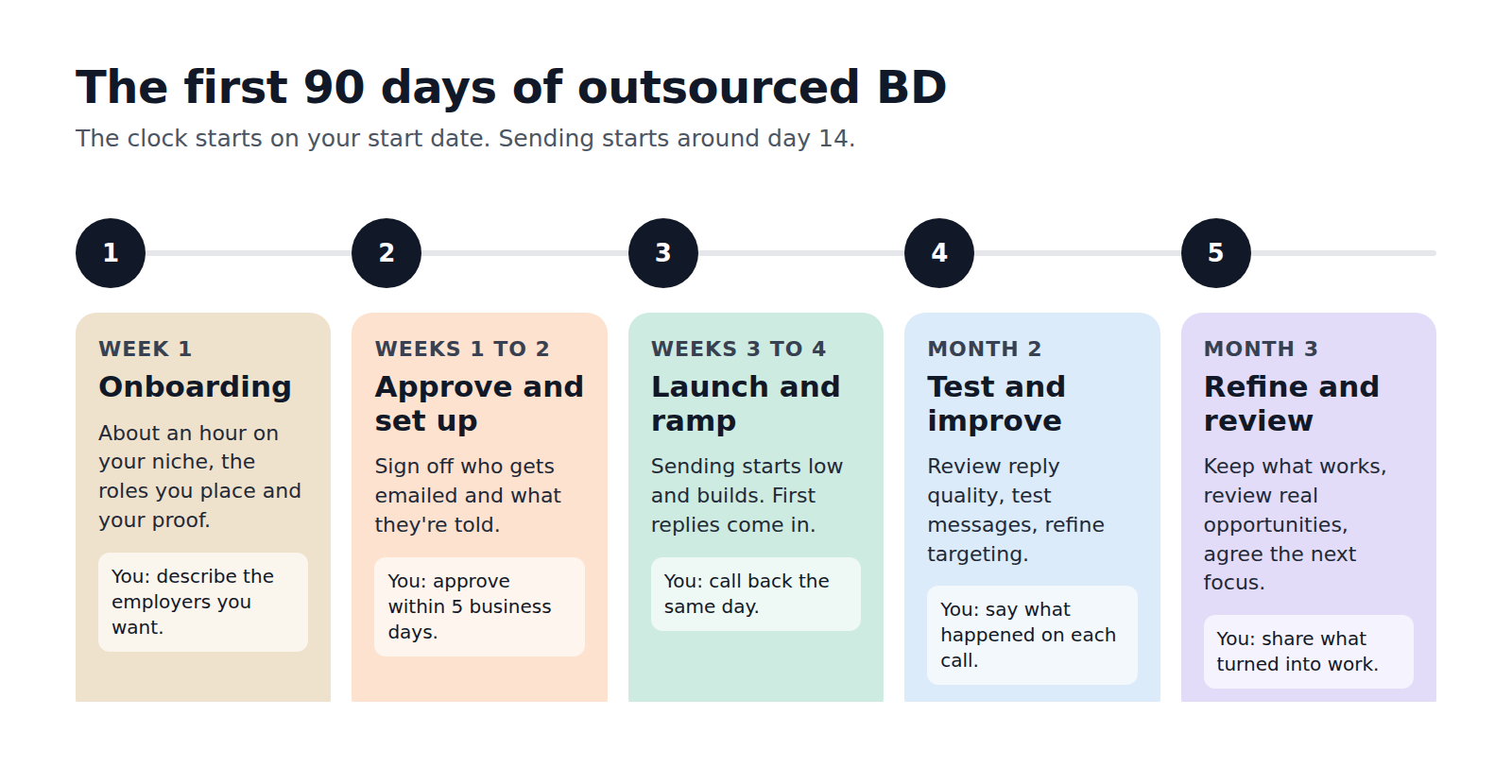
In the first 90 days of outsourced business development, expect two weeks of setup, sending from about day 14, your first employer replies from around weeks 3 to 4, and most of the results in months 2 and 3. By day 90 you should be able to count how many interested employers you've heard from, how many of them you've met, and what your market is telling you. Signed clients and placements usually come next, on your own sales cycle.
That's the timeline when it's going well. Below, we walk through each month: what should be happening, what you should be doing, and what good and bad look like at day 30, 60 and 90.
If you're still deciding whether to outsource at all, start with is outsourcing business development worth it for a recruitment agency? For pricing, see what outsourced business development costs a recruitment agency in Australia. This piece assumes you've signed and want to know what the first three months should look like.
Why it takes 90 days, not 30
A campaign spends its first two weeks getting ready. Someone has to agree your niche and the employers who fit it, find the hiring managers, write the emails, and set up sending domains so your main inbox stays safe. You approve the audience and the messages before anything goes out.
Then sending starts low and ramps up. Each employer gets a short sequence of emails, not one, and many of the replies come on the later ones. In Careers in Demand's campaigns, about four in five interested replies came on the second or third email. So the employers you write to in week 3 may not reply until week 5 or 6.
That's why judging a campaign after one month doesn't tell you much. The first month is mostly setup and ramp. In our experience, the second and third months are where you refine and the replies build.
Days 1 to 30: setup, approval and first sends
What should happen. An onboarding call in week 1 (ours is about an hour) covering your niche, the roles you place and what makes you different. Then you sign off who gets emailed and what they're told. Sending starts around day 14, at low volume, and builds towards full volume over the following weeks.
What you do. Turn approvals around quickly. Every week the audience or emails sit in your inbox is a week of sending you don't get back. We ask clients to finish onboarding and approve the emails within 5 business days.
Good at day 30:
- sending is live and you've seen the emails going out in your agency's name
- the employers on the list are ones you'd actually want as clients
- you know where interested replies will reach you and who on your team takes them
- you may already have your first replies, possibly a first interested employer
Worrying at day 30:
- sending hasn't started and nobody can tell you why
- you haven't seen or approved a single email
- the list is full of job titles in industries you don't recruit for
- you're being sent opens and clicks instead of replies
No interested employer by day 30 isn't a reason to worry. Sending has only been running for about two weeks. What matters is that the setup is right.
Days 31 to 60: replies build and the market starts talking
Sending is at full volume, the later emails in each sequence are going out, and replies pick up.
What should happen. Your provider reads every reply, filters out the noise and sends interested employers straight to your team. Month 2 is also for testing: reviewing reply quality, trying different messages and tightening which employers you target.
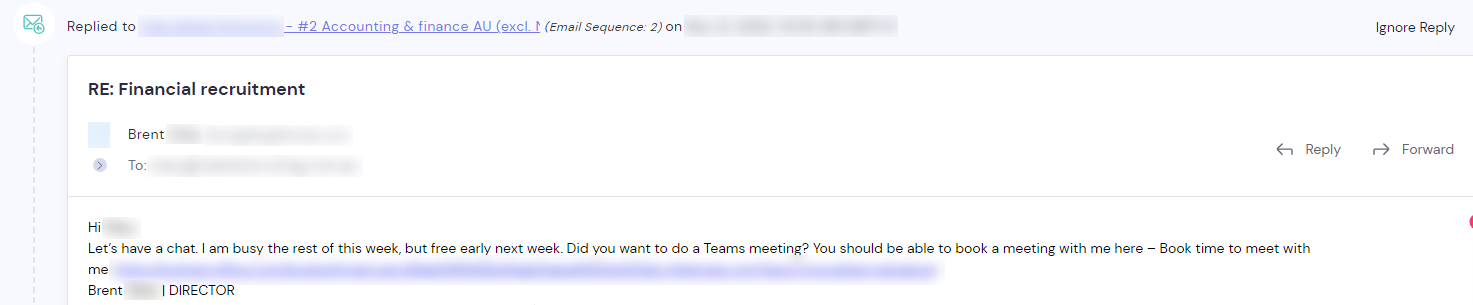
What you do. Call back every interested employer the same day if you possibly can. An employer who replies on Tuesday and hears back on Friday has usually found someone else. Then tell your provider what happened on the call. Without that feedback, they're guessing.
What the market tells you
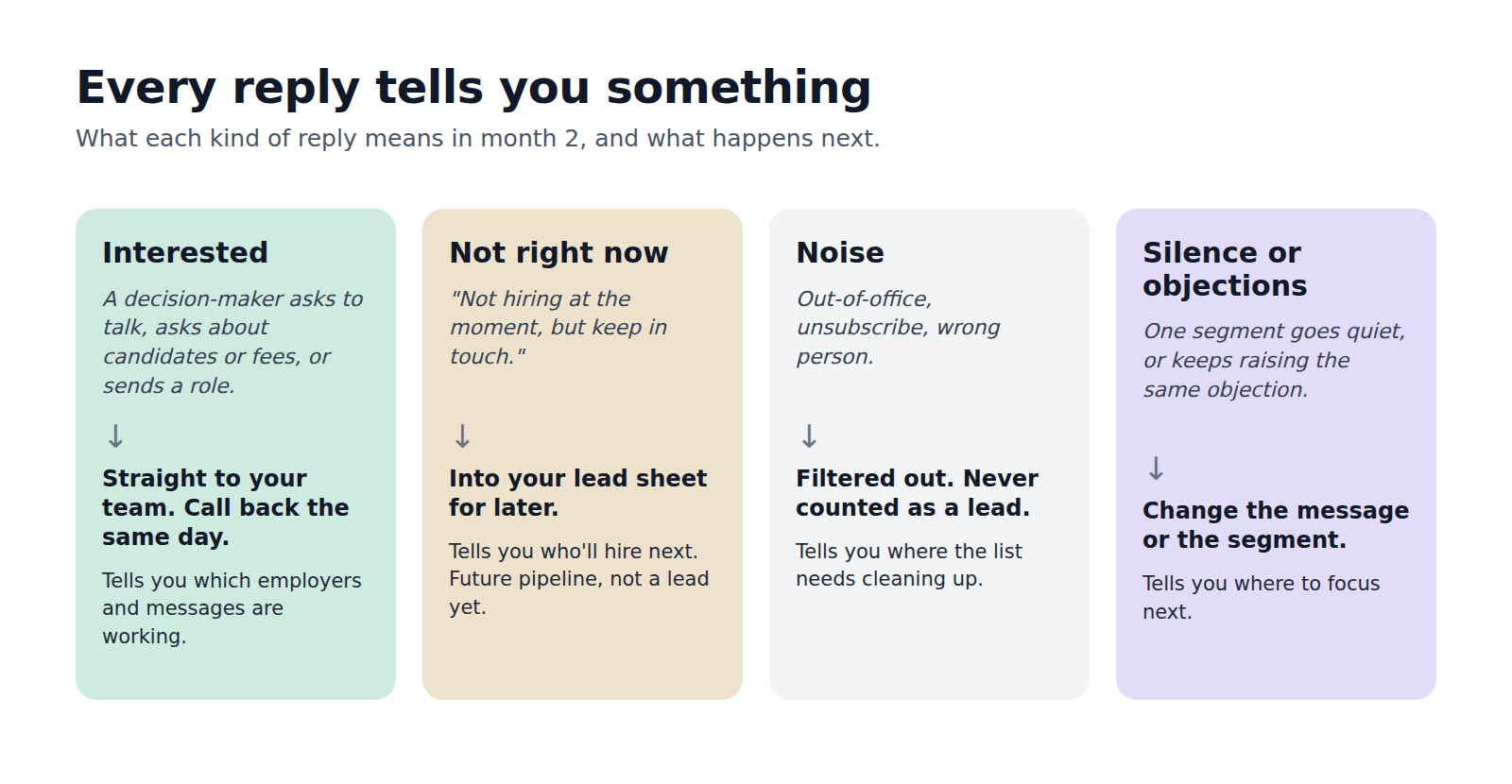
Interested replies aren't the only thing you get in month 2. The whole inbox is feedback:
- Interested replies show which employers, roles and messages are working. A decision-maker asks to talk, asks about candidates or fees, or sends you a role.
- "Not right now" replies tell you who'll hire later. They don't count as interested, but they're future pipeline. Careers in Demand, an education and VET recruiter, has 174 of them to go back to across four 2026 campaigns.
- Silence from one segment while another replies tells you where to focus. That's what the month 2 targeting changes are for.
- Objections, such as employers who say they only use agencies on a preferred supplier list, show you what your offer is up against before your consultants spend time on it.
Good at day 60:
- interested employers are arriving and your team is calling them back the same day
- you've had your first meetings with employers you didn't know before
- you can see which part of your niche is replying and which isn't
- your provider has changed something based on the replies, not just kept sending
Worrying at day 60:
- interested replies are sitting for days before anyone calls
- out-of-office and unsubscribe replies are being counted as leads
- the meetings you're getting are with people who can't give you work
- nothing has changed since launch, even though one message or segment is clearly flat
Days 61 to 90: refine, review and count
What should happen. Keep what works and drop what doesn't. By now there's enough data to see which employer types, roles and messages produce interested replies. At the end of the period, sit down together and review the real opportunities: who's interested, who you've met, who's briefed you and what's still open. Then agree the next focus.
Meeting volume. The meetings depend on how many interested employers you get and how many of them you get on a call. As an example, the default assumptions in our calculator at recruitment.clck.au have half of interested employers taking a meeting, so 20 interested employers would mean about 10 meetings. Your rate depends on your niche, your offer and how fast you call back. Our cost guide carries that example through to clients and fees.
Good at day 90:
- you can count interested employers against a definition you agreed in writing at the start
- you've met a meaningful share of them and you're working on briefs or terms
- you have a list of "not right now" employers to follow up later
- you know which segment and message to put more into for the next quarter
Worrying at day 90:
- nobody can tell you how many employers were genuinely interested
- your provider is reporting activity (emails sent, opens) instead of conversations
- interested employers came through but your team didn't follow them up
- you're being asked to sign a longer term before anyone has reviewed the results with you
Good and bad at a glance
| Good looks like | Bad looks like | |
|---|---|---|
| Day 30 | Sending is live in your agency's name, to employers you'd want as clients. First replies may be in. | Sending hasn't started, you haven't approved anything, or you're being shown opens. |
| Day 60 | Interested employers arriving and called back the same day. First meetings held. Targeting changed based on replies. | Replies sitting for days, junk counted as leads, nothing changed since launch. |
| Day 90 | An agreed count of interested employers, meetings held, briefs in progress and a plan for the next quarter. | No agreed count, activity reports instead of conversations, interested employers never followed up. |
What a good start can turn into
Fast follow-up is what turns early replies into clients. One recruitment firm signed 6 new clients in 15 days from its first 20 positive replies, and 10 clients in total from that campaign.
Mary B., Managing Director of Calculated Solutions, a financial services recruitment agency, said: "Within the first month of our first campaign, I started securing clients."
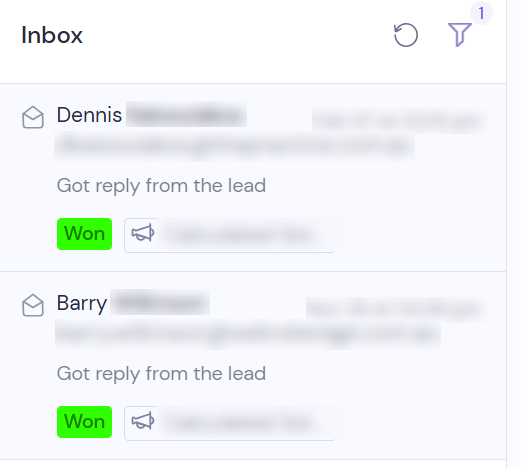
Careers in Demand heard from 96 interested employers across four 2026 campaigns and has made 8 placements so far. Read the Careers in Demand case study.
Your results will depend on your niche, your fees and how quickly your team follows up. A placement can take longer than 90 days to land, and no outreach provider can honestly promise one. What you should have by day 90 is the conversations that lead to placements.
What your agency needs to do
Most of the work sits with your provider, but four things decide whether the first 90 days go well, and they sit with you:
- Give the onboarding call your full attention. The emails are only as specific as the niche you describe.
- Approve the audience and the emails quickly.
- Call back interested employers the same day.
- Tell your provider which conversations turned into meetings, briefs and placements.
How we run the first 90 days
We run outbound lead generation for Australian recruitment and staffing agencies. We find the hiring managers in your niche, email them every weekday in your agency's name and send the ones who want to talk straight to your team.
Our 90 days, and the guarantee, run from your start date, with sending from around day 14. We guarantee 20 interested employers in that time, or we keep working for free until you hit that target. "Interested" means a decision-maker asks to talk, asks about candidates or fees, or sends you a role. Out-of-office, "not now" and unsubscribe replies don't count. It's three months to start, then month to month.
Next step
If you'd like to see what the first 90 days could look like in your niche, apply for a free planning session. We'll look at your market and tell you what's realistic, including if outsourcing isn't the right move yet.
Questions agency owners ask
How soon will we get our first reply?
Sending starts around day 14 and ramps up slowly, so early replies often land in the first month. We can't promise yours will, which is why we judge the campaign over 90 days.
How many meetings should we expect in 90 days?
It depends on how many interested employers you hear from and how many you get on a call. Using our calculator's default assumption that half of interested employers take a meeting, 20 interested employers would mean about 10 meetings. Treat that as an example, not a promise.
Should we judge it after 30 days?
No. At day 30, sending has usually been running for about two weeks. Check that the setup is right: the right employers, emails you're happy with and someone ready to take every interested reply. Judge the results at day 90.
What if we're at day 60 with nothing?
Ask three questions. Is sending actually at full volume? Are the employers on the list the right ones? Have any interested replies been missed or left without a call back? If all three check out, the month 2 testing should be changing the message or the segment. If nothing is changing, push for it.