

You've had a good conversation. The person understands what you do, the fit seems right, and then they say, “We're interested, but we're not ready yet.”
Fair enough. Buying decisions take time, especially when there's a significant cost, a team to consult or a change to how the business works.
The awkward part is what comes afterwards. You don't want to disappear, but you don't want to become the person sending “just checking in” every fortnight either.
Our recommendation is to base the follow-up on what's holding the decision up. That gives you something relevant to say and gives the buyer a reason to reply, even if they're still a few months away.
Find out what “not ready” means
Before you start sending anything, ask one more question.
“No worries. What's the main thing you need to sort out before you can move ahead?”
You might learn that their budget review is in November. Or that the person you're speaking with needs to explain the idea to their business partner. Perhaps they're worried about how much work the change will create for an already busy team.
Those are different situations. They need different follow-ups.
Keep the question relaxed. You're trying to understand their position, not talk them out of it. If they don't want to go into detail, accept that. “Not ready” can also be a polite way of saying no.
When there is a genuine next step, agree on it together: “Would it make sense for us to touch base after your budget meeting?” That's a better starting point than silently adding them to a weekly chase-up list.
Send something that helps with the decision
You don't need a library of polished resources. A short explanation in an email can do the job. The question is whether it addresses something this person actually needs to work through.
If you're choosing what to send, start here:
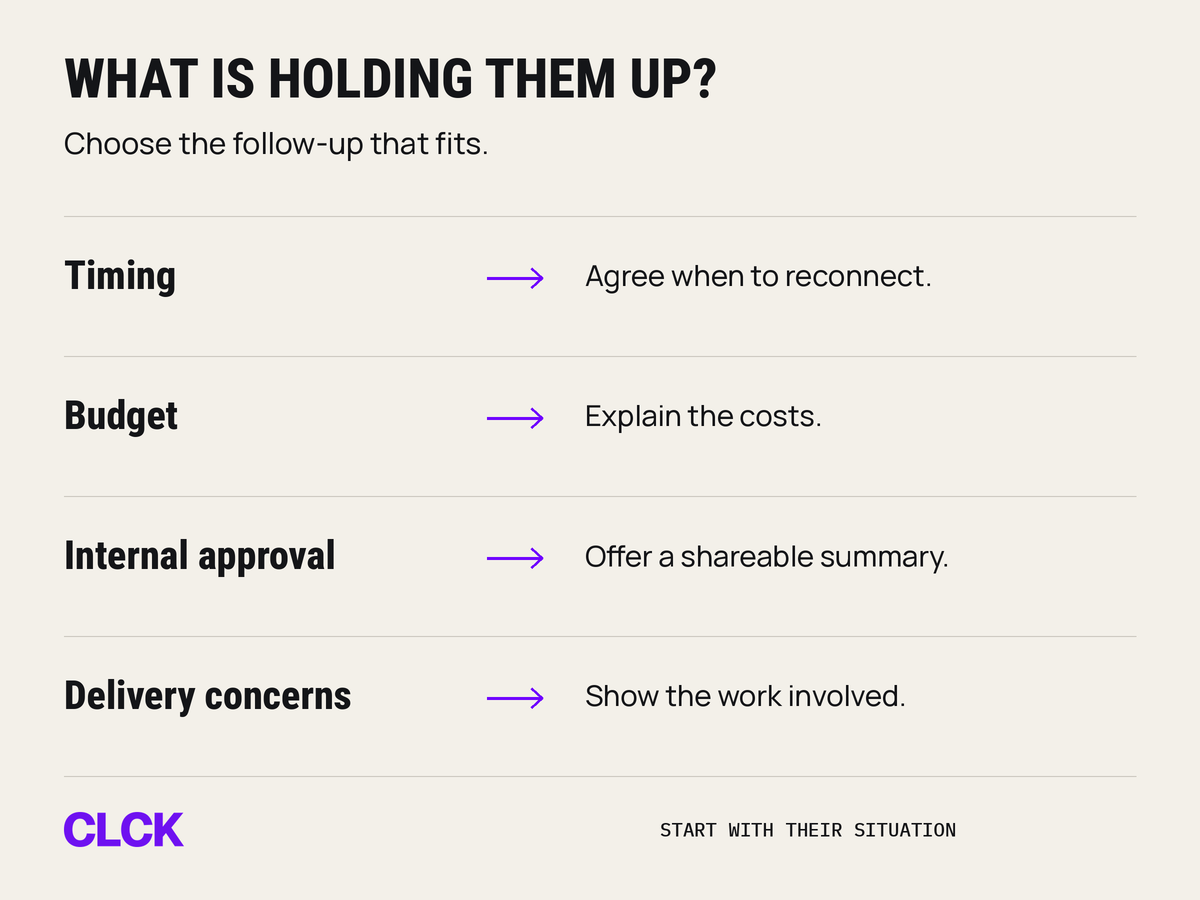
If the timing isn't right
Someone who's asked you to come back after a busy period may simply need the space they've asked for. Sending more content won't make their current project finish sooner.
Confirm the timing and put a reminder in your CRM. If you've promised a document in the meantime, send it. Otherwise, it's fine to wait.
Here's an example of how that could sound:
Thanks for letting us know, Sam. Let's leave this with you while the office move is underway. Would the first week of November be a good time to pick it up again?
Only use a date like that if it fits the conversation. The point is to agree on the next contact, not find a clever way to keep emailing.
If they need to work through the cost
A cost question doesn't always call for a discount. They may need to understand what's included, which costs repeat, or what their own team will need to contribute.
Send a short breakdown that answers the actual question. Be upfront about costs you can't confirm yet. If a smaller first step is genuinely available, explain what it would include and what would wait.
You mentioned needing to see the ongoing cost as well as the initial setup. We've separated those in the attached breakdown, including the software costs and the work your team would need to handle. Is there anything else you'd need for the budget discussion?
This example assumes you have that breakdown ready to send. Don't promise savings, a return or a cheaper option you haven't established.
If someone else needs to approve it
Your contact may be interested but still have to make the case internally. A long proposal isn't always easy to pass on, particularly if the next reader missed the original conversation.
Offer a short summary they can forward. Explain the problem they're trying to solve, your proposed approach, the cost and what it would involve for their team. Use their priorities, rather than a page about your business.
Would a short summary help with the conversation with your business partner? We can pull together what we discussed, the cost and what's involved for your team, so they don't have to work through the full proposal.
Ask before sending more material. And let your contact decide whether to introduce the other person, rather than going around them.
If they're worried about the work involved
The price might be manageable while the disruption feels daunting. Think of a business considering a CRM change when its sales team is already flat out.
A realistic outline of the work can help: who needs to be involved, what information is needed, when decisions are required and where the busy periods are likely to fall.
A relevant case study can help too, provided it explains a genuinely comparable situation. Avoid sending a glossy success story that leaves their main concern unanswered.
Be honest about what you don't know. If you haven't scoped their migration, you can't promise that it will take two weeks or need almost no input from them.
Make the message easy to answer
These examples are starting points, not scripts to paste into every conversation. Keep the person's circumstances in the message and remove anything that doesn't apply.
A good follow-up can be brief. Remind them why you're writing, explain what you're sending or asking, and give them one question they can answer without doing homework.
“Has the budget meeting happened yet?” is easier to respond to than “Have you had a chance to consider all the options outlined in our proposal?”
Use the existing email conversation where it makes sense. They shouldn't have to work out who you are or why you're contacting them again.
Keep enough detail in HubSpot to pick up naturally
Once you've agreed on a next step, write it down. “Follow up later” won't tell you much when the reminder appears six weeks from now.
Record the reason for the delay, what you've already sent and the next contact you've agreed on. Give that action an owner and a date.
For example: “Waiting for November budget review. Send the revised cost breakdown before the meeting. Alex to reconnect the following week.”
In HubSpot, you can create a task associated with the contact or deal, assign it to a team member and add a due date and notes. That's enough to start without building a new automation.
If your team regularly misses agreed follow-ups, our article on HubSpot workflows covers reminders and ownership in more detail. Keep the reminder separate from the decision to send: someone should still check the latest conversation before contacting the buyer.
Know when to leave it there
If someone asks you to stop, stop. A request to reconnect about a proposal also shouldn't be treated as permission to add them to ongoing marketing emails.
If the agreed date passes and your follow-up gets no reply, there's no universal number of messages you should send. Consider the relationship, what was agreed and whether you have anything new to add. Silence isn't a reason to increase the pressure.
Where a final note fits the relationship, keep it straightforward:
It sounds like this may have moved down the list for now. We'll leave it here, but you're welcome to pick it up with us if the timing changes.
Then follow through. Don't send a “last email” and keep chasing the following week.
Start with the conversations you already have
Choose a few people who've said they're interested but aren't ready. Can you explain what's holding each decision up? Do you know what happens next?
If the answer is yes, follow through on what you've agreed. If you don't know, a short, respectful question may be more helpful than another article or brochure.
That's the approach we'd take: understand their situation, send something that addresses it, and give them room to decide.
If keeping track of those conversations is the hard part, we can help you organise HubSpot and your follow-up. Apply for a strategy session to talk it through.