
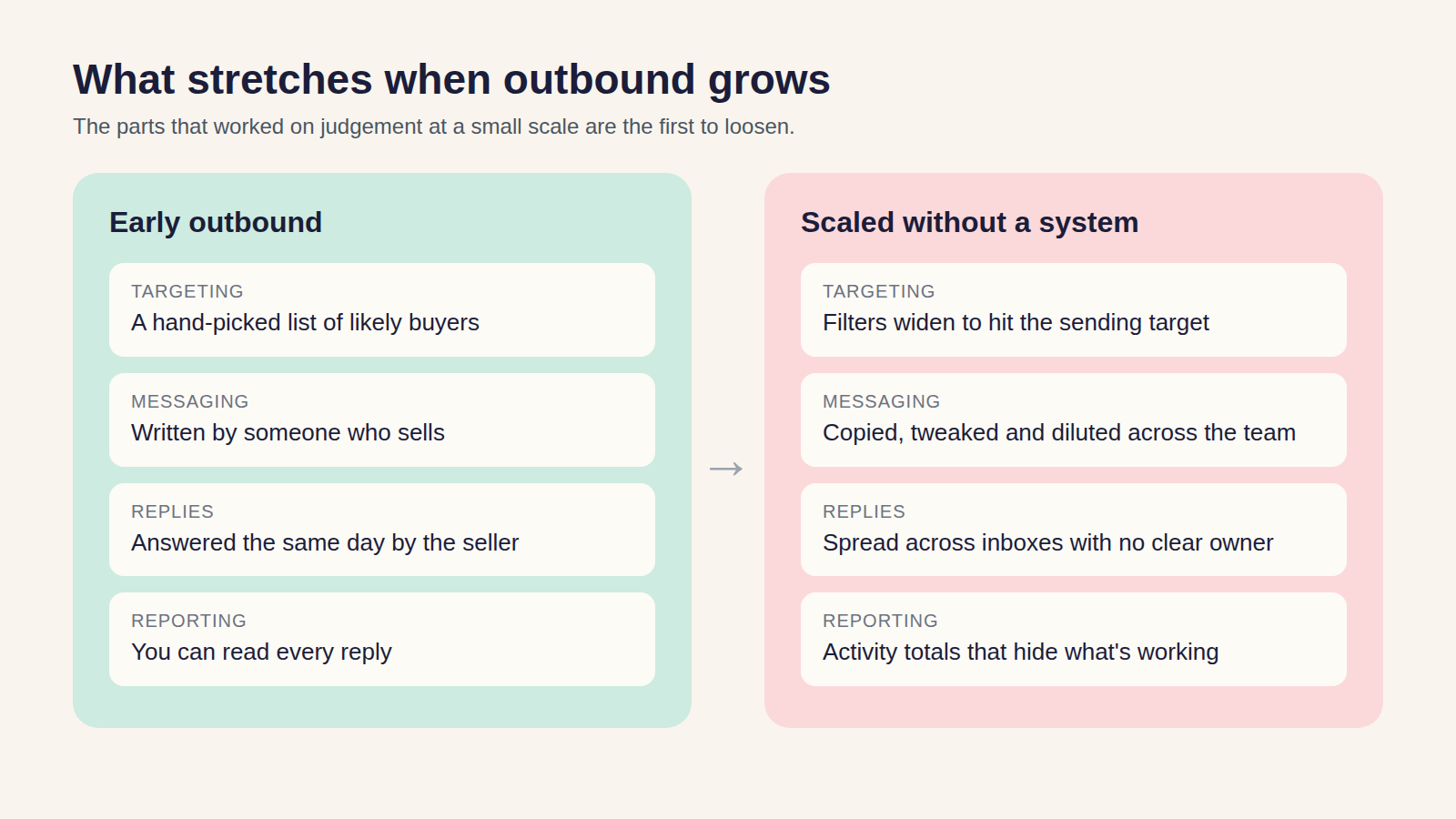
B2B companies struggle to scale outbound lead generation because volume magnifies whatever is loose in the setup. Early outbound usually works on a small, hand-picked list, a message the founder wrote and replies answered by the person who sells. When you add contacts, people and channels, those three things stretch: the list widens to keep up with the sending targets, the message gets copied and diluted across the team, and the sales process that lived in one person's head has nobody steering it.
So the fix is rarely more volume. It's tighter targeting, sharper messaging and a sales process designed to handle more conversations, put in place before you turn the volume up.
We run outbound for Australian B2B companies, and a campaign that worked at a small scale and then flattened out is one of the most common things we're asked to look at. This article is about that point. If your problem is the wrong people turning up to meetings, start with why outbound lead generation books unqualified meetings. This one is about why results don't grow when your effort does.
Why outbound works at first
The first campaign often goes well for reasons nobody wrote down.
The founder or a senior salesperson picks the accounts, because they know which companies have the problem. The message comes from someone who has had the sales conversation a hundred times. Replies land in the inbox of the person who'll take the call, so a "tell me more" gets a thoughtful answer the same day.
Small and focused can go a long way. One campaign we ran for a lead-management software business contacted 338 people, rather than thousands of loosely matched names, and produced 37 interested replies, 15 booked meetings and four new clients within 40 days. A small list chosen with care can do a lot.
The trouble starts when the next step is "do that again, but ten times bigger". Most of what made the small version work was judgement, and judgement doesn't copy across to a bigger list, a new hire or a sequencing tool on its own.
Where outbound breaks as it grows
Here are the five places a growing outbound program usually stalls. Most teams have two or three of them at once.
1. The good accounts run out, so the list gets wider
Every market has a limited number of companies that genuinely fit. When a team sets a sending target of a few thousand contacts a month, it often burns through the best-fit accounts in the first few months. To keep the numbers up, someone loosens the filters: a bigger headcount range, a neighbouring industry, a more junior job title.
Each change looks small. Together they turn a list of likely buyers into a list of companies that only look like buyers on paper. Reply rates drop, the team sends more to make up for it, and the cycle repeats.
The fix is to size the market before you set the volume. Work out how many companies actually fit, how many people at each one are worth contacting, and how often you can reasonably approach them. If the honest answer is 600 accounts, the plan should be built around 600 accounts, with deeper research for the best ones, rather than a monthly quota that forces the list wider.
2. Targeting is decided by whoever builds the list
With one person running outbound, the ideal customer lives in their head and that's mostly fine. Add two more people, an agency or an AI research tool, and everyone starts making their own call about who belongs on the list.
One rep keeps chasing companies that are too small because they reply. Another adds a region because it has more contacts. Exclusions get missed, and current customers or open deals end up in a cold sequence.
The fix is a written targeting brief with one owner: the company types, sizes and locations you want, the roles you need to reach, the reasons an account belongs on the list, and the exclusions. In our B2B lead generation work, current customers, existing opportunities and do-not-contact records come out before anything is sent. When the brief changes, it changes for everyone at once.
3. The message gets diluted as more people write it
The founder's first email usually works because it sounds like someone who understands the buyer's problem. Then it gets turned into a template. Each new rep tweaks a line. Someone adds a case study that suits a different market. AI tools start producing variations at scale.
Six months later, the team is sending dozens of versions of a message that has drifted away from the offer and the proof that worked. Nobody can say which version is doing the work, because too many things changed at once.
The fix is a small, approved message library: the offer, the angle for each segment, the proof you're allowed to use and the ask. People and tools adapt from that, rather than writing from scratch. Test changes in stages, one variable at a time, so you can see what moved the result. AI can help apply a good message across more accounts, but it won't fix a weak offer, and a confident-sounding AI sentence can still be wrong about the business it's describing.
4. Replies outgrow the process for handling them
This is the one that catches growing teams out. At a small scale, reply handling is informal and quick because one person does it. At a larger scale, replies arrive across several inboxes, LinkedIn accounts and team members, and nobody is quite sure who owns which one.
An interested reply waits two days. A "not right now" never gets a follow-up date. A salesperson takes a call without seeing the original message. The campaign is producing interest, and the business is quietly losing it.
The fix is to design the process before you need it:
- Who owns each reply, by segment, territory or channel, so nothing sits unclaimed.
- How fast you respond, with a target your team can actually meet.
- What happens to each kind of reply: interested, curious, not now, not a lead.
- Where it's recorded, so the next person can see the conversation and the next step.
If replies and next steps keep falling between inboxes and the CRM, fix that first. Our guide on when to fix HubSpot before scaling lead generation covers the warning signs.
5. Reporting can't tell you what to change
Small campaigns are easy to read. You can look at 30 replies and know what's working. At volume, teams fall back on activity numbers: emails sent, connection requests, open rates, meetings booked. Those tell you the machine is running. They don't tell you which segment, message or rep is producing customers.
Without that, every slow month leads to the same decision: send more. We covered why a meeting count on its own is misleading in the unqualified meetings article. For scaling, the extra step is to split the numbers by segment and message, so you can see where the next contact should go, and to get sales feedback on which conversations went somewhere.
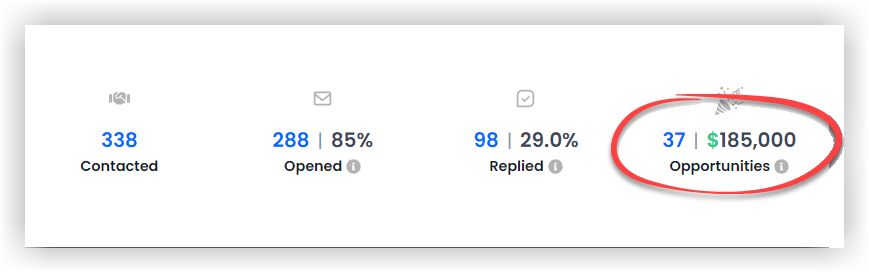
In that software campaign, 98 replies became 37 interested prospects. A report that showed only the 98 would have made the campaign look better than it was. A report that showed only the 37 wouldn't have told you which part of the list they came from. Both matter when you're deciding where to put the next 1,000 contacts.
Targeting, messaging and sales process: what to fix first
When outbound stalls, the instinct is to fix it with more: more contacts, more reps, more automation, a second channel. We'd fix three things first, in this order.
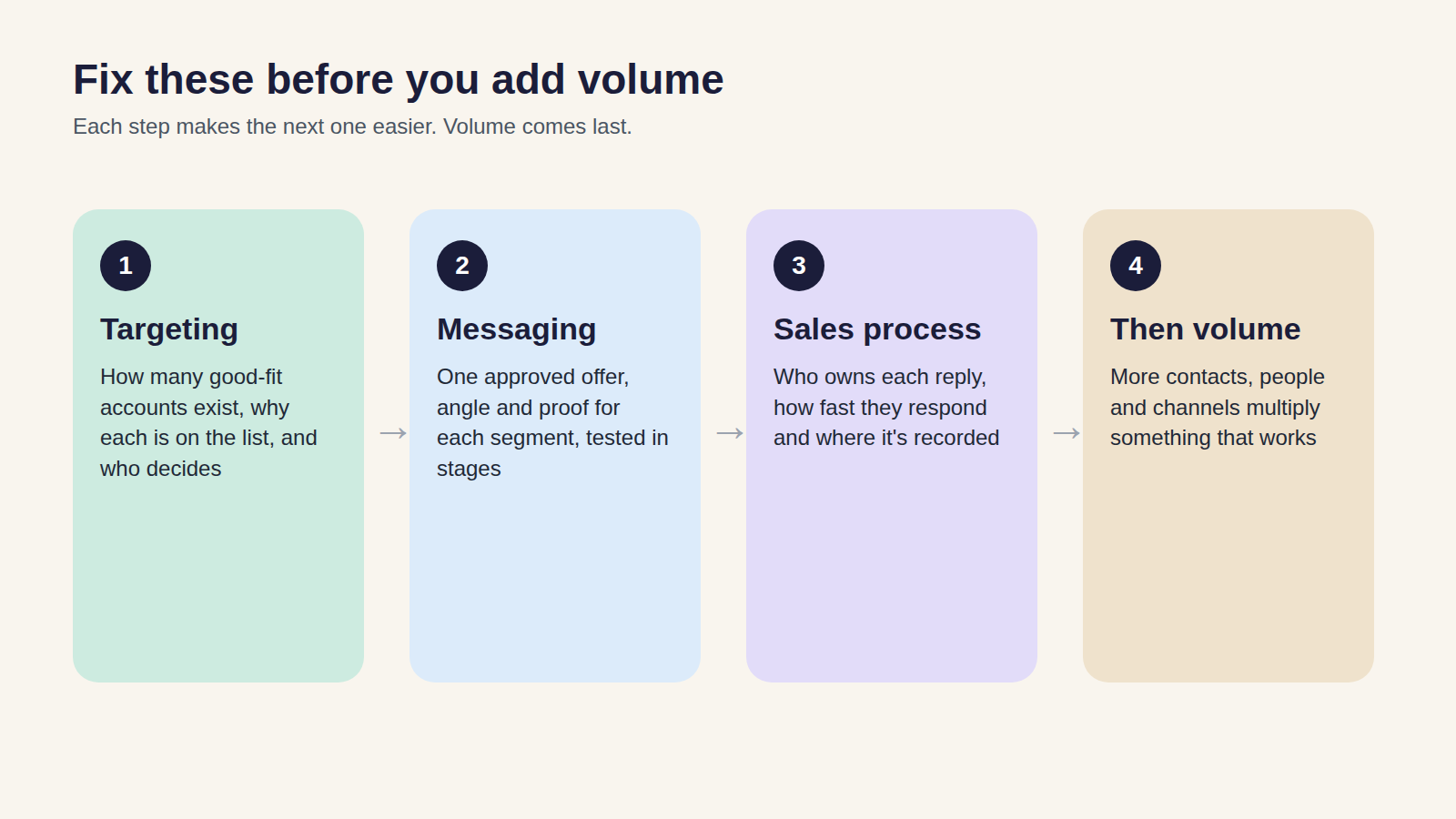
Targeting. Know how many good-fit accounts exist, why each one is on the list and who decides. This tells you how much volume your market can take before quality drops.
Messaging. Agree the offer, the angle for each segment and the proof, and put it in one place everyone works from. This keeps the message sharp when more people and tools are sending it.
Sales process. Decide who owns each reply, how fast they respond, what happens next and where it's recorded. This is what turns extra interest into extra customers instead of extra admin.
Then add volume. With those three in place, more contacts and more people multiply something that works, instead of multiplying the leaks.
How to scale outbound more predictably
You don't need to rebuild everything at once. This is the sequence we'd follow.
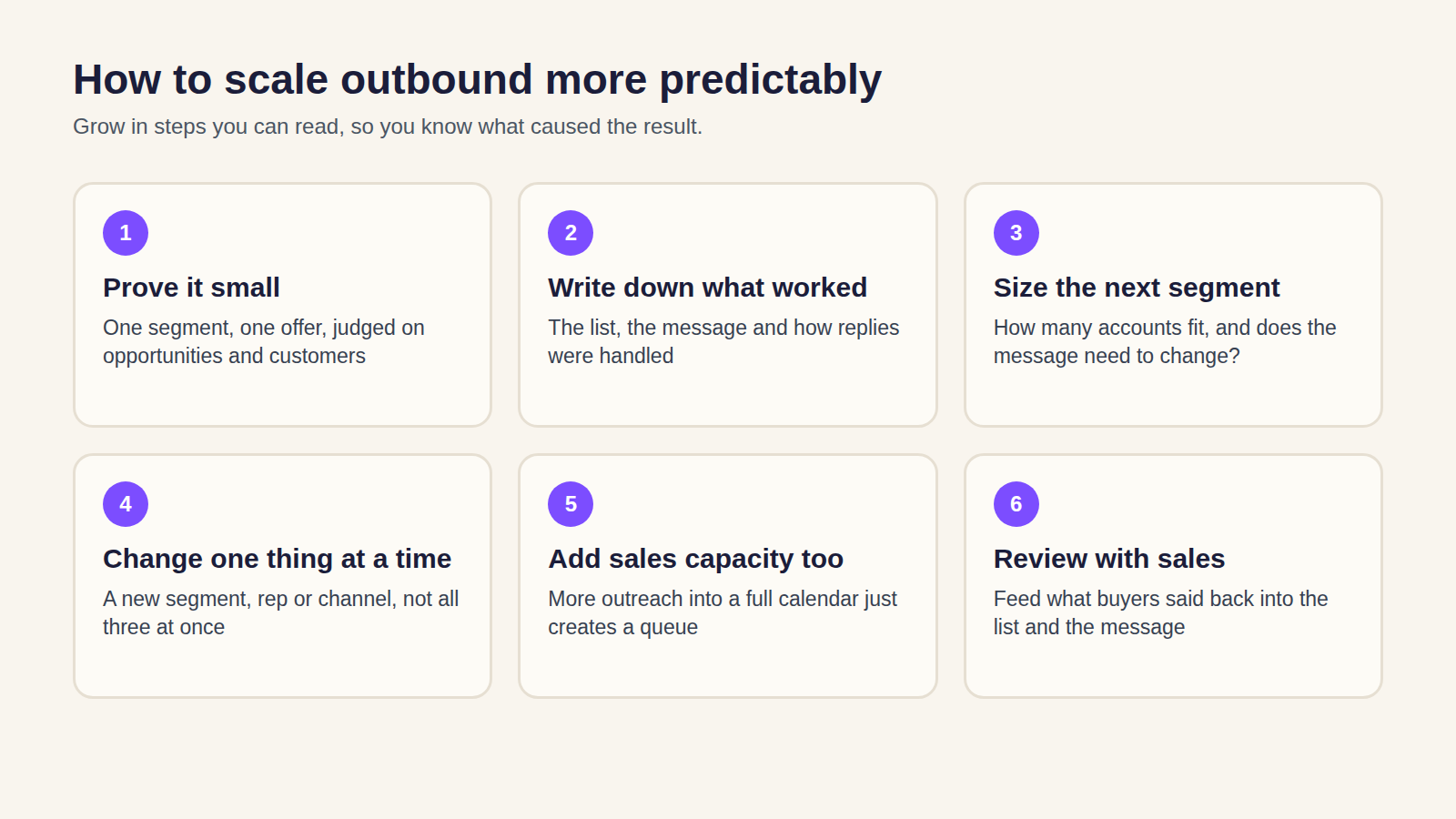
- Prove it small first. Run a focused test on one segment with one offer, and judge it on opportunities and customers. One client closed two new clients from four sales calls in an initial tester campaign, then expanded the outbound program internationally. The test earned the expansion.
- Write down what made it work. Who was on the list and why, the message and proof, and how replies were handled. This becomes the brief for everyone who joins.
- Size the next segment before you enter it. Check how many accounts fit, and whether the message and proof need to change for that market.
- Change one thing at a time. A new segment, a new rep or a new channel, not all three in the same month. Otherwise you can't tell what caused the result.
- Add capacity to the sales side when you add volume. If the people answering replies and taking calls are already full, more outreach just creates a queue.
- Review with sales every few weeks. Which conversations went somewhere, which missed and what buyers said. Feed that back into the list and the message.
Adding a channel is part of this too. LinkedIn and cold email do different jobs, and a second channel can widen your reach into the same good-fit accounts. It also adds coordination work, so the targeting and reply process need to be solid before you run both. Our comparison of LinkedIn and cold email for B2B service businesses helps you work out which one leads, and hybrid outbound covers running them together.
Is your outbound ready to scale?
Before you add volume, people or a channel, check where you stand.
| Question | Ready to scale | Fix this first |
|---|---|---|
| How many good-fit accounts are left? | You know the number and the plan fits it | The list only grows by loosening filters |
| Who decides who goes on the list? | One written brief with one owner | Each person builds their own list |
| Where does the message come from? | An approved library, tested in stages | Everyone writes and edits their own |
| Who owns each reply? | Named owners and a response target | Replies sit in shared inboxes |
| Can you see which segment produces customers? | Results split by segment and message | Only activity totals |
| Can sales take more conversations? | There's room in the calendar | The team is already at capacity |
If most of your answers sit in the right-hand column, more volume will make things harder, not better. Fix those first, then scale.
Frequently asked questions
Why does outbound lead generation stop working as you send more?
Usually because the extra volume comes from accounts that fit less well, sent a message that has drifted, to replies nobody has time to handle properly. Sending more amplifies what's already in the campaign. If the list, message and reply process are tight, more volume helps. If they're loose, it makes the problems bigger.
Should we hire more SDRs to scale outbound?
Only once the targeting, messaging and reply process are written down and working. New hires copy whatever system they walk into. If that system lives in one person's head, each new person adds their own version of the list and the message, and results get harder to read.
Can AI help us scale outbound?
AI can research and sort companies, find reasons an account might care and adapt an approved message to different buyers. That lets a small team cover more of the market with relevant outreach. It can't decide who your best customers are, and with a weak definition it will reach more of the wrong people faster. Our AI prospecting playbook covers what to set up first.
How do we know when to add cold email, LinkedIn or both?
Start with how your buyers make decisions. If they need to recognise your expertise before they reply, LinkedIn often leads. If your market is well defined and reachable, cold email can give you direct reach. Add a second channel when one isn't reaching enough of the right accounts, and when your team can keep the follow-up joined up across both.
Next step
If your outbound worked at the start and has flattened out since, look at the table above and pick the first thing in the right-hand column. If you'd like a second opinion on your targeting, messaging and sales process before you add more volume, book a strategy session. We'll look at where your outbound is losing ground and what to fix before you scale it.