
LEAD GENERATION
Outsource lead generation or hire an SDR?
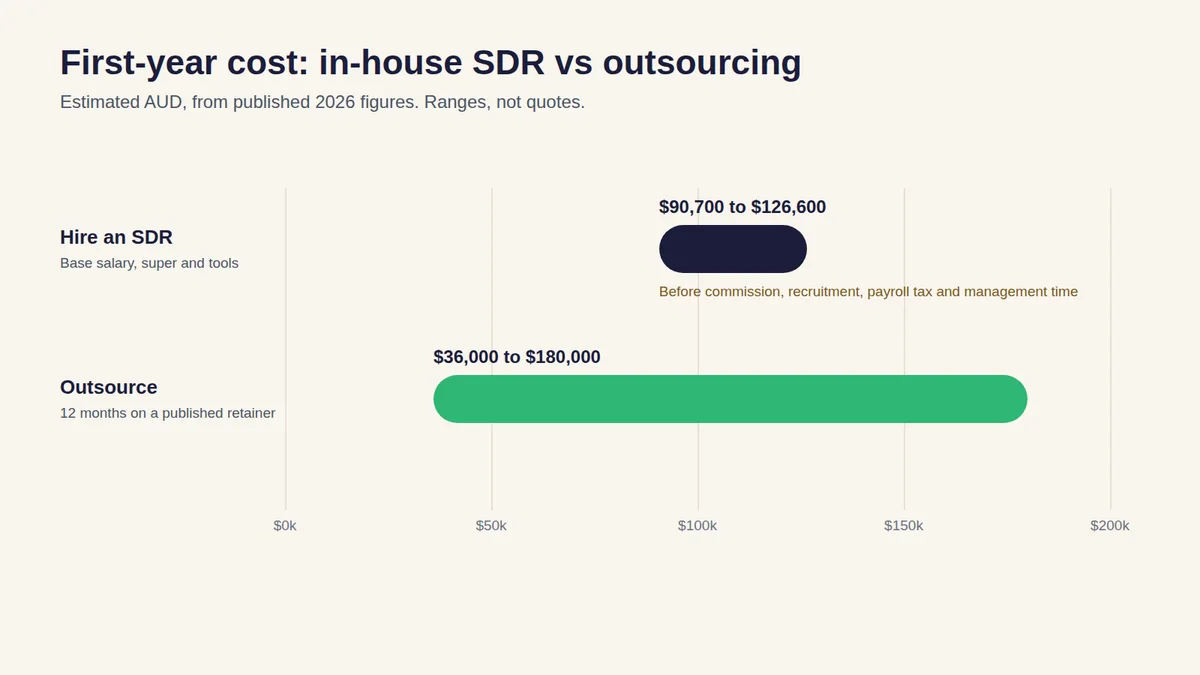
For most Australian B2B companies that don't yet have outbound working, outsourcing lead generation is the cheaper and faster way to start. A specialist team can usually be sending within a few weeks, and published Australian retainers start at around $3,000 a month. An in-house sales development representative (SDR) costs an estimated $90,700 to $126,600 in the first year before commission, recruitment and management time, and takes about three months to ramp up after you've found them. Hiring an SDR makes more sense once you know who to target, what to say and how replies get handled, and you have someone to manage the role.
On cost, timing and channel: outsourced B2B lead generation in Australia usually costs $3,000 to $15,000 a month on a retainer, or about $200 to $600 per qualified meeting. Setup takes two to three weeks, and you should give a campaign about three months before you judge it. Cold email still works in Australia when the list is tight, the message is relevant to the reader's role and you follow the Spam Act 2003.
We run outbound for Australian B2B companies, so we have a view. Below are the numbers behind that answer, with sources, and the situations where hiring is the better call.
Outsource or hire an SDR: the short comparison
| Hire an SDR | Outsource lead generation | |
|---|---|---|
| First-year cost | About $90,700 to $126,600 before commission, recruitment and management | About $36,000 to $180,000 for 12 months on a published retainer |
| Time to first outreach | Recruiting time, plus setting up data, tools and sending | About 10 to 15 business days for setup and warm-up |
| Time to full output | About 3 months of ramp after they start | About 3 months of testing and refining |
| What you provide | Targeting, messaging, tools, coaching and a manager | Market knowledge, approvals and someone to take interested calls |
| When the person leaves | Outreach stops until you hire again | Staff changes are the provider's to cover (check how they handle them) |
| Best when | Outbound already works and you can manage the role | You're starting or restarting outbound and need it running soon |
The rest of this page explains where each number comes from.
How much does outsourced B2B lead generation cost in Australia?
Most Australian providers charge a monthly retainer, a fee per meeting, or a mix of the two. These are the ranges they publish.
| Pricing model | Typical AUD range | Source |
|---|---|---|
| Monthly retainer | $3,000 to $15,000 a month | J2 Group |
| Pay per qualified meeting | $200 to $600 a meeting | J2 Group |
| Dedicated outsourced SDR, phone-led, B2B tech | $6,000 to $14,000 a month, or $450 to $950 a meeting | UpliftSales |
| Multi-channel prospecting | $4,000 to $15,000+ a month | Telemarketing Professionals |
What moves the price within those ranges:
- Channels. Email alone costs less than email plus LinkedIn plus phone. Calling time is the most expensive part of most campaigns.
- Market size and data. A tight market needs fewer contacts and less data than a national list across several industries.
- Copy and testing. Messages written for each segment take more work than one template sent to everyone.
- Reply handling. Someone has to read every reply and pass on the interested ones quickly. Cheaper offers often skip this.
- Sending setup. Separate sending domains and gradual warm-up protect your main domain. They take time and cost money to run.
Ask what's inside the fee and what's billed on top. J2 Group notes that a $5,000 monthly quote can climb to $9,000 once data, onboarding and tooling are added back in. With pay per meeting, check how the contract defines a qualified meeting. If the definition is loose, you pay for calendar entries with people who were never going to buy. We cover that trap in why outbound lead generation books unqualified meetings.
Our own B2B lead generation campaigns start from $3,500 a month. Your exact price depends on your market, the campaign scope and the work involved, and you get it before you commit. If you run a recruitment agency, our recruitment business development cost guide works through the same question using placement fees.
What does an in-house SDR cost in Australia?
Here's a rough first-year estimate for one SDR, built from current public figures.
| Cost line | Estimate (AUD a year) | Source |
|---|---|---|
| Base salary | $70,000 to $90,000 | SEEK, typical SDR salary in Australia |
| Super at 12% | $8,400 to $10,800 | ATO super guarantee rate |
| Tools (CRM seat, data, sending, dialler, LinkedIn) | $12,300 to $25,800 | UpliftSales tools table |
| Total before the extras below | $90,700 to $126,600 | Our sum of the lines above |
That total leaves out several costs you'll still pay:
- commission or a bonus, which most SDR roles carry on top of base salary
- payroll tax, if your total wages are above your state's threshold
- the cost of recruiting, whether that's an agency fee or your own hours
- the time someone senior spends managing and coaching the role
Some salaries in SEEK's data include super, so treat the estimate as a starting point.
Then there's ramp. The Bridge Group's 2025 survey of 351 B2B companies, mostly North American software businesses, found new SDRs take 3.0 months on average to reach full productivity. The same survey puts average SDR tenure at 1.9 years and median annual attrition at 40%. In practice, you pay full salary while the person learns, and there's a fair chance you'll be hiring again within two years.
For comparison, 12 months on a published retainer of $3,000 to $15,000 a month comes to $36,000 to $180,000. Most of that range sits below the in-house estimate, but a top-end retainer can cost more than a junior hire. Compare what each option actually covers: an SDR is one person, while a provider usually brings data, sending infrastructure, copywriting and reply handling with the fee.
How long does outbound lead generation take to get results?
Expect two to three weeks of setup, early replies in the first month or so, and about three months before you can judge the campaign properly. How quickly replies turn into customers then depends on your sales cycle.
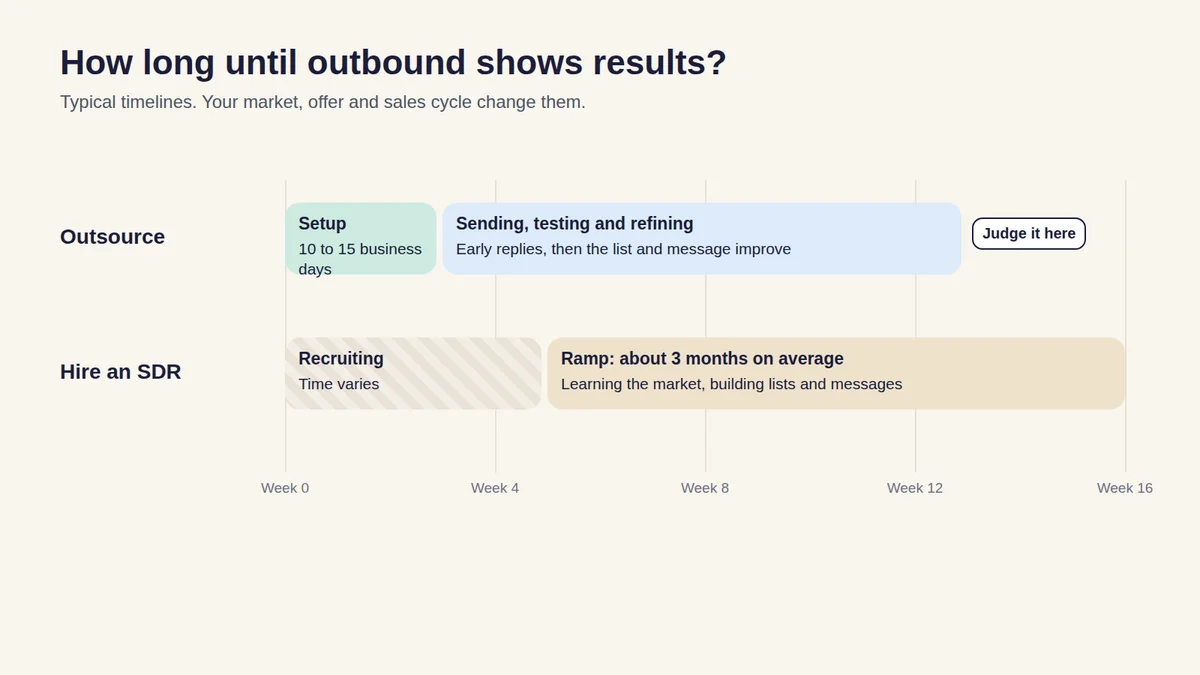
If you outsource, setup and warm-up for our managed outbound typically takes around 10 to 15 business days. That covers targeting, messaging approval, separate sending domains and warming the inboxes. Sending then starts at a low volume and builds. The first few months are mostly list testing, inbox care, learning which messages land and handling replies, so give a campaign about three months before you judge it.
Early results do happen, but they vary with the offer and market. Some examples from past campaigns:
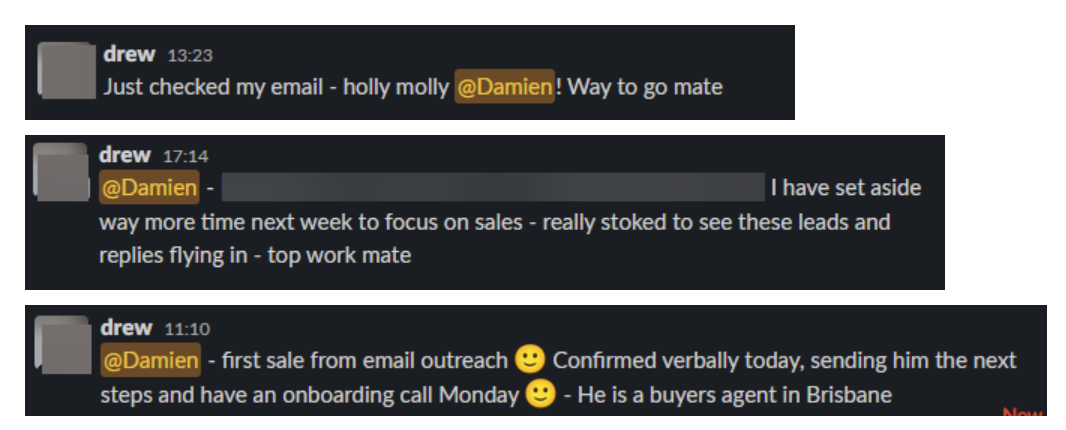
- A lead-management software business reached 338 targeted contacts and won four new clients within the first 40 days.
- A commercial solar business booked 11 quotes alongside 16 real opportunities in under three weeks.
- A recruitment business had 20 positive replies in its first 15 days, which turned into six new clients.
- A business directory closed 15 new clients over three months of outreach.
These are separate historical campaigns, not averages or forecasts.
If you hire, the clock starts later. You need time to recruit, then the SDR needs about three months to ramp. If you don't already have data, sending domains and tested messages, they'll be building those while they learn your market.
Is cold email still effective for B2B lead generation in Australia?
Yes, when it's targeted and handled properly. What has stopped working is high-volume, generic email sent to bought lists.
Two things changed. First, inbox providers got stricter. Since February 2024, Google has required anyone sending to Gmail accounts to authenticate their domain with SPF or DKIM and keep reported spam rates below 0.3%, with extra rules for bulk senders. Sending thousands of loosely targeted emails from your main domain is now a fast way to land in spam. Second, generic templates are easy to spot, and an email that could have gone to anyone usually gets treated that way.
What still works is a small, well-researched list, a short message that's relevant to the reader's role and a quick, thoughtful response when someone replies. We send from separate domains and inboxes, warm them gradually and monitor delivery, so your main business domain doesn't carry the campaign.
The results bear that out. The software campaign above came from a list of 338 people, not thousands of loosely matched names: 37 interested replies, 15 meetings and four new clients. A commercial cleaning campaign signed four new clients worth more than $100,000 a year. Another campaign turned 18 interested prospects into six confirmed proposals in 15 days.
The Spam Act 2003: what cold email in Australia has to do
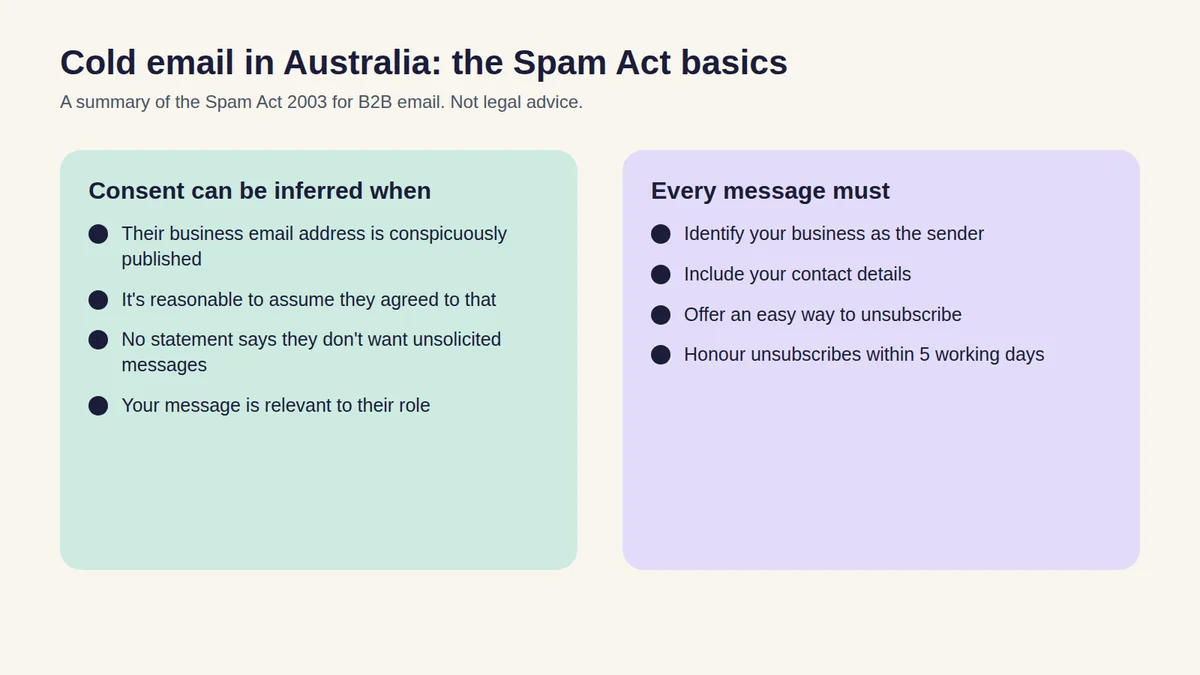
In Australia, commercial email is covered by the Spam Act 2003, and you need consent before you send. For cold B2B email, consent can be inferred when:
- the person's business email address has been conspicuously published, for example on their company website
- it's reasonable to assume it was published with their agreement
- there's no statement next to it saying they don't want unsolicited commercial messages
- your message is relevant to their role or function in the business
Every message also has to identify your business, include your contact details and give an easy way to unsubscribe, which you must honour within five working days. If someone sends messages for you, they still have to identify your business as the sender. This is a summary, not legal advice, so check your own situation and treat these rules as the minimum.
Cold email isn't the right first channel for every business. If your buyers need to recognise your expertise before they'll reply, LinkedIn may lead. Our comparison of LinkedIn and cold email for B2B service businesses helps you choose, and hybrid outbound covers running both.
When hiring an SDR is the better choice
Hiring makes sense when most of these are true:
- Outbound already works. You've proven which accounts to target, what to say and how replies are handled, and it's written down for a new person to follow.
- Someone can manage the role. An SDR needs coaching, call reviews and feedback from sales every week. Without that, ramp takes longer and good people leave.
- The work goes beyond outreach. If you need someone who also calls accounts, attends events and builds relationships over months, a person on your team does that better.
- Your market can keep someone busy for years. A full-time role needs enough good-fit accounts to work through without loosening the targeting.
- You want the skill in-house long term. Building your own team keeps the knowledge in the business, as long as you can keep the people.
When outsourcing makes more sense
Outsourcing tends to be the better choice when:
- You haven't proven outbound yet. Testing a market or offer through a provider costs less than hiring someone to find out.
- Nobody has time to recruit and manage an SDR. In many founder-led businesses, the person who'd manage the hire is also the person selling.
- You need conversations this quarter. Setup takes weeks. Hiring and ramping an SDR takes months.
- You don't want to build the infrastructure. Data, sending domains, warm-up, copy and reply handling come with the fee.
Neither option fits if nobody can respond to interested prospects quickly, or if you need a guaranteed number of customers by a fixed date. No honest provider or new hire can promise that.
Can you do both?
Yes, and many businesses end up there. Two common ways:
- Outsource first, then hire. Use a provider to prove the targeting, messages and reply process. When it works, you have a documented playbook for an SDR to step into.
- Outsource the outreach, keep the conversations. The provider finds the accounts, sends the emails and filters the replies. A senior person on your team takes every interested call, so the relationships stay with your business.
Frequently asked questions
Is outsourced lead generation the same as an outsourced SDR?
Not always. An outsourced SDR usually means a dedicated rep, often phone-led, working your accounts. Outsourced lead generation can also cover the targeting, data, copywriting, email infrastructure and reply handling around that work. Ask each provider exactly what's included.
Is pay per meeting cheaper than a retainer?
It can be, but only when "qualified" is clearly defined in writing. A loose definition rewards booking anyone who'll take a call. Compare the cost per meeting that turns into a real sales opportunity, not the headline fee.
Will cold email put our main domain at risk?
It shouldn't if it's set up properly. We use separate sending domains and inboxes, warm them up and monitor delivery. That keeps the campaign off your main domain, but no provider can guarantee inbox placement, so relevant messages and responsible sending still matter.
Do we need a CRM before we start?
No. We can work with HubSpot, another CRM or no CRM. What you do need is someone who can respond to interested prospects quickly and record what happened next.
Next step
If you're weighing up a hire against outsourcing, start with the comparison table above and be honest about who would manage an SDR. If you'd like a second opinion on your market, offer and the numbers for your business, book a strategy session. We'll talk through whether outbound makes sense for you, what it would take and where we'd start.