

Outsourcing business development is worth it for a recruitment agency when three things are true: BD keeps stopping whenever your desk gets busy, you can describe your niche in a sentence, and someone on your team can call an interested employer back the same day. If any of those is missing, you'll usually get more from fixing it first, or from doing the work yourself.
That's the short answer. The longer one depends on what's actually stopping your BD now, because outsourcing fixes some problems well and doesn't touch others. Below are the five questions we'd work through before spending a dollar, and how outsourcing compares with hiring a BDM or doing it yourself.
What you'd actually be handing over
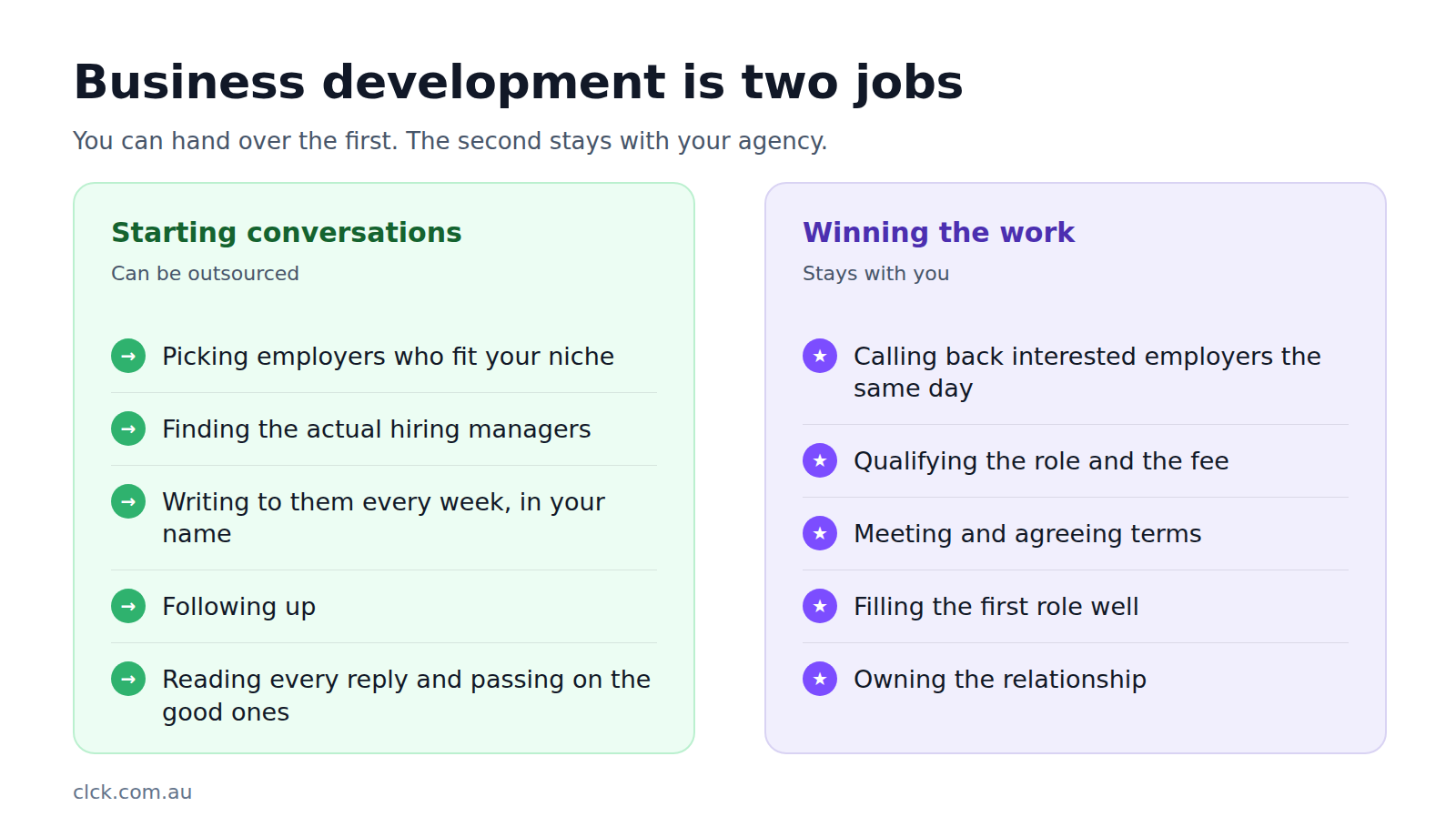
Business development in a recruitment agency is really two jobs.
The first is starting conversations: picking the employers who fit your niche, finding the hiring managers, writing to them, following up and reading every reply. It's steady, repetitive work, and it's the part that disappears when roles go live.
The second is winning the work: calling back the employer who's interested, qualifying the role, running the meeting, agreeing terms and filling the first role well. That depends on your market knowledge and your relationships, and it stays with you.
A good outsourced provider takes the first job off your plate. It can't do the second. So the better question is whether you'd win more clients if new employer conversations turned up every week, busy or not.
Five questions that decide it
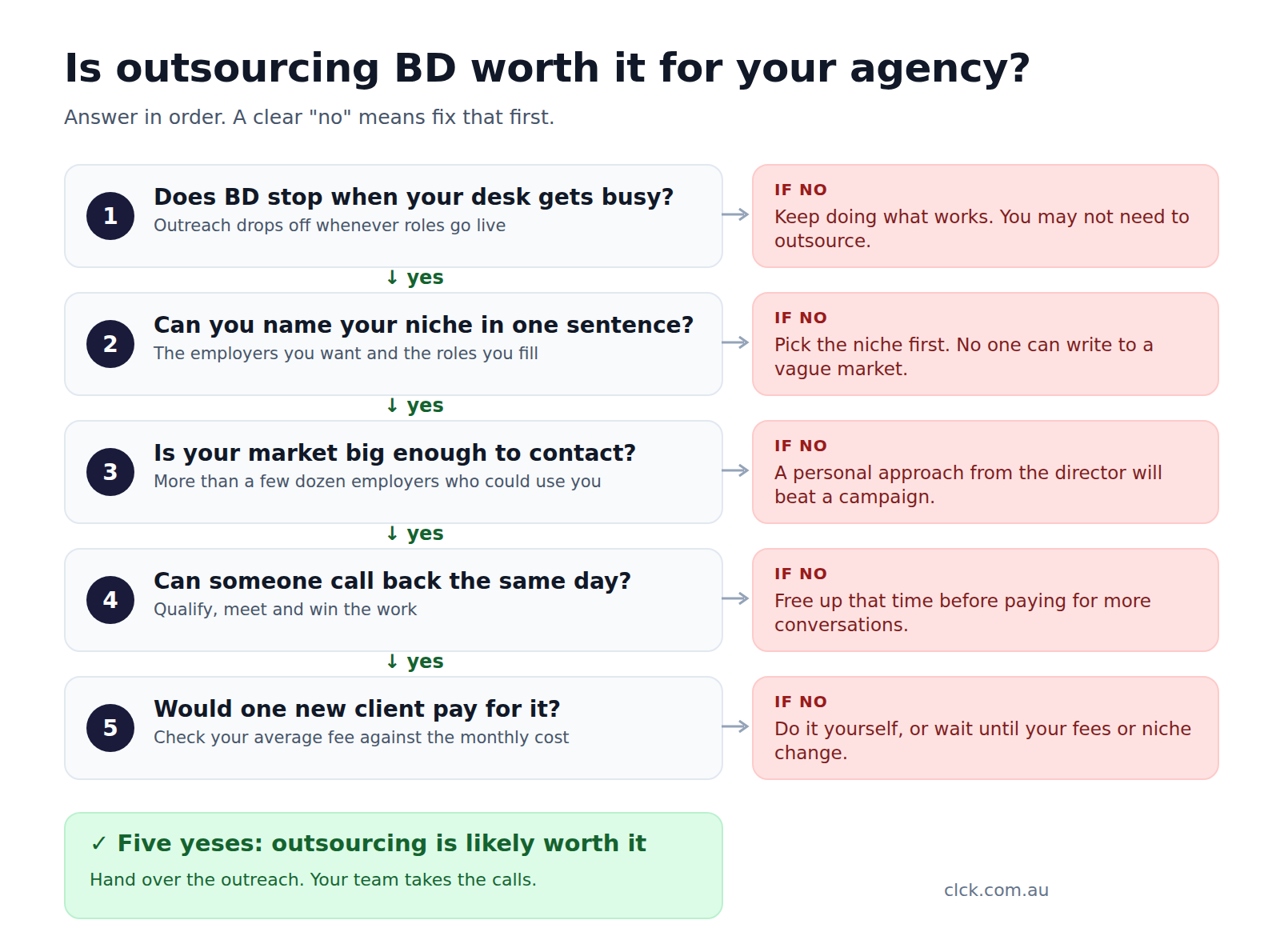
Work through these in order. If the answer is "no", stop there and fix that first.
1. Does BD stop when your desk gets busy?
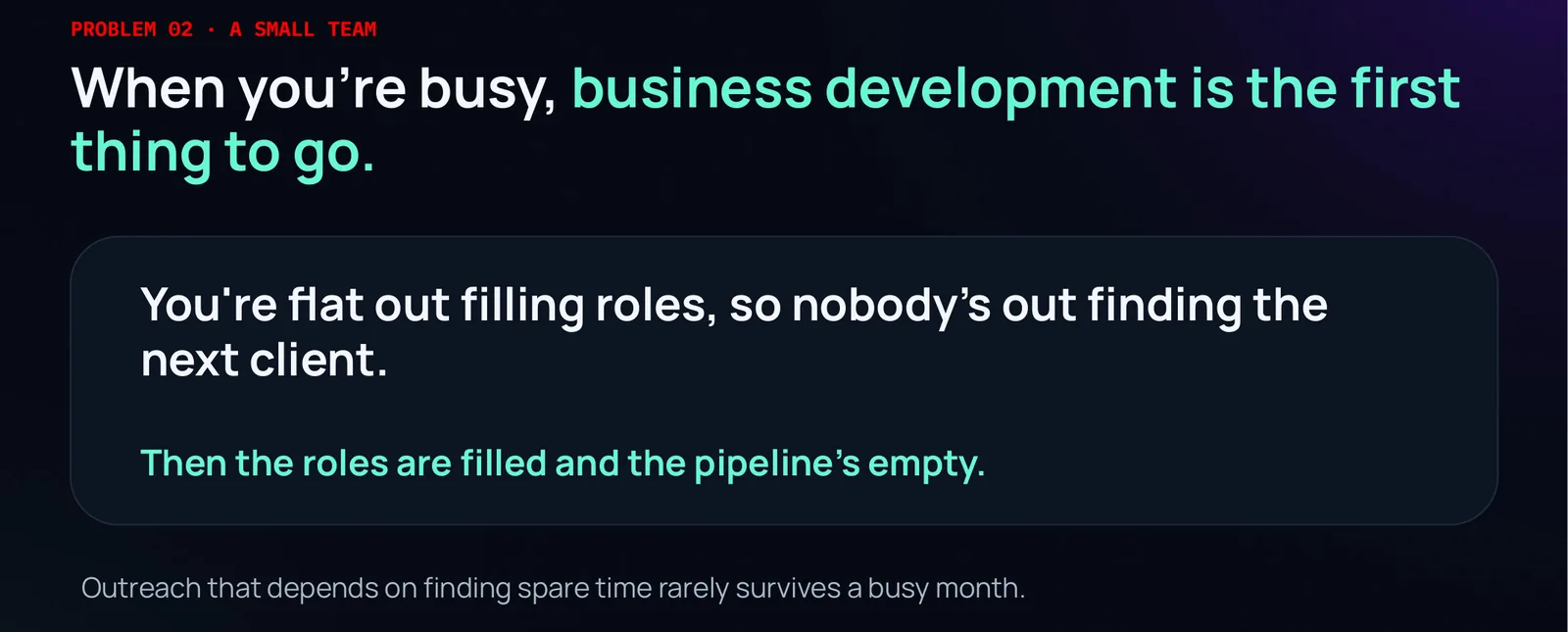
This is the problem outsourcing solves best. In most small agencies, the people who could find new clients are the same people filling roles. When roles are live, outreach drops to nothing. A month later the roles are filled and the pipeline's empty.
If that sounds familiar, what you're short of is time and routine, and that's the part a provider can take on. If your BD already runs every week and referrals keep every desk full, you probably don't need to outsource anything yet.
2. Can you describe your niche in one sentence?
"We place aged care managers with residential providers in regional Victoria" is a niche. "We do a bit of everything" isn't.
The emails that get replies sound like they came from someone who knows the employer's world. A provider can only write that way if you can tell them which employers you want and which roles you fill. If you can't yet, an outsourced campaign will spend your money working it out.
3. Is your market big enough to contact?
A campaign needs enough employers to write to every week. If only a few dozen businesses could ever use you, a personal approach from the director will usually beat a campaign. Pick up the phone, use your network and keep that short list warm.
If there are hundreds of employers who hire the roles you fill, outsourced outreach has room to work. Most of them won't be advertising this month, and hardly anyone talks to them before they do. We explain why that window matters in how niche recruiters reach hiring managers before roles are advertised.
4. Who'll call back an interested employer the same day?
This is the question agencies skip, and it's the one that decides results. An employer who replies on Tuesday and hears back on Friday has usually found someone else.
Outsourcing hands you conversations. Someone on your team still has to take them: call back, qualify the role and meet. If nobody has room for that, free up the time before you pay anyone to start more conversations.
5. Would one new client pay for it?
Recruitment has one big advantage when you do the maths: a single placement is worth a lot. One placement at an average fee usually covers the first 3 to 6 months of a campaign, and a good employer client rarely hires just once.
So the test is simple. If a campaign won you one new employer client in its first few months, would you be ahead? If one placement at your fee covers the first 3 to 6 months, as it does for most agencies, the answer is yes. For the pricing models, typical Australian ranges and a worked payback example, see our guide to what outsourced business development costs a recruitment agency in Australia.
Outsource, hire a BDM or do it yourself?
Outsourcing isn't the only answer. Here's how the three options compare.
| Do it yourself | Hire a BDM | Outsource the outreach | |
|---|---|---|---|
| Best when | You have time each week and enjoy prospecting | You want someone in the market who also runs meetings and builds relationships in person | BD keeps stalling and you want new conversations every week |
| What it costs you | Your own hours, plus tools and data | A full salary from day one, plus super, tools and a few months to ramp up | A monthly fee, plus your time on calls with interested employers |
| Main risk | It stops the moment you get busy | It stops when they're on leave or move on | A poor provider sends generic email in your name |
| Who wins the work | You | The BDM, or you | You |
Doing it yourself is the cheapest option, as long as you keep doing it. Judge that by your busiest month.
A BDM can be the right call when you want someone in the market full time, at events and in meetings. Outsourced outreach won't replace that. It covers the part that takes the most time: finding employers, emailing them every week, following up and reading replies. Our cost guide puts an estimated first-year BDM cost next to typical outsourced retainers if you want the numbers side by side.
You can also combine the two: outsource the outreach and have the director or a senior consultant take every interested call. The relationships stay in-house, and nobody spends their week on lists and follow-ups.
When it isn't worth it
Outsourcing BD is probably a poor use of money if:
- referrals already keep every desk full and you're turning work away
- you haven't settled on a niche yet
- nobody can follow up interested employers quickly
- you want a spreadsheet of names to call yourself (that's a data purchase, and much cheaper)
- you need guaranteed placements, which no outreach provider can honestly promise
- you'd judge it after one month. The first month is mostly setup and ramp, which is why three months is a common minimum.
What it looks like when it's worth it
Careers in Demand, an education and VET recruiter, had been relying heavily on its own network for new clients. Across four 2026 campaigns, it heard from 96 interested employers and has made 8 placements so far, with another 174 employers saying "not right now" to go back to. Its director put it this way: "We were hesitant at first about making the financial investment, but the return on investment has far exceeded our expectations." Read the Careers in Demand case study.
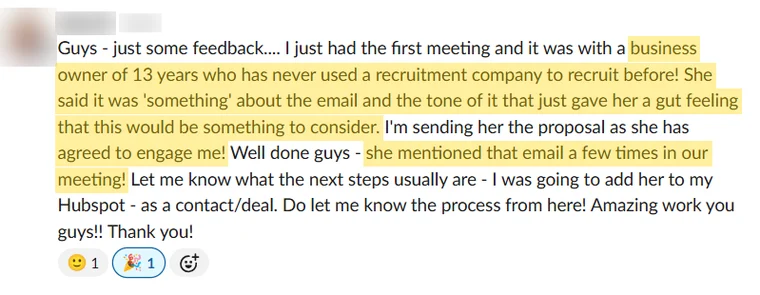
Another recruitment firm signed 6 new clients in 15 days from its first 20 positive replies, and 10 clients in total from that campaign.
Mary B., Managing Director of Calculated Solutions, a financial services recruitment agency, said: "Within the first month of our first campaign, I started securing clients."
Your results will depend on your niche, your fees and how quickly your team follows up. The same campaign does very little for an agency that leaves replies sitting for a week.
Before you sign with anyone
Three checks matter most. What counts as a result, in writing? Whose name do the emails go out under, and how is your main domain protected? Who reads the replies, and how fast do interested ones reach you? Our cost guide has the full list of questions to ask a provider.
How we approach it
We run outbound lead generation for Australian recruitment and staffing agencies. We find the hiring managers in your niche, email them every weekday in your agency's name and send the ones who want to talk straight to your team. You approve the audience and the messages, and you own every relationship.
We guarantee 20 interested employers in your first 90 days, or we keep working for free until you hit that target. "Interested" means a decision-maker asks to talk, asks about candidates or fees, or sends you a role. It's three months to start, then month to month. If you'd like to test the maths on your own fees first, try the calculator at recruitment.clck.au.
If cold email is the part you're unsure about, we've covered that separately in does cold email work for recruitment agencies?
Next step
If you're weighing up whether to outsource BD, apply for a free planning session. We'll talk through your niche, your market and whether outsourcing makes sense for your agency right now, including if it doesn't.
Questions agency owners ask
Is it cheaper to outsource BD or hire a BDM?
Across most of the published price range, outsourcing costs less in the first year, mainly because a BDM is a full salary from day one plus a few months of ramp. A BDM does more than outreach, though, so compare the work you actually need done. Our cost guide has the numbers.
How long before you know whether it's working?
Give it three months. Setup takes a couple of weeks and sending ramps up slowly, so early replies often land in the first month. In our experience, the second and third months are where you refine and the replies build.
Can a one or two person agency outsource BD?
Yes, if one of you can call back interested employers the same day. With us, your time at the start is about an hour, so we can get across your niche and the roles you place. After that, your part is the calls.
Will outsourced outreach hurt our reputation?
It can if it's done badly: bought lists, generic emails or cold email sent from your main domain. Ask to approve every message, and check that sending happens from separate domains so your everyday email to candidates and clients isn't affected.