
RECRUITMENT COST GUIDE
What does outsourced business development cost for a recruitment agency in Australia? (2026)
Last updated: 12 October 2026
Those ranges come from Australian providers' own published pricing, mostly for general B2B outbound. Below we break down the pricing models, what changes the price, how a BDM compares, and the maths on when it pays for itself. We run outbound campaigns for recruitment agencies, so we have a view, and we'll tell you where outsourcing isn't worth it too.
The pricing models, with typical AUD ranges
Most providers in Australia charge one of four ways. Here's what each one usually costs, with the source for every range.
| Pricing model | How you pay | Typical AUD range | Source (date on page) |
|---|---|---|---|
| Monthly retainer | A flat monthly fee for data, copy, sending, follow-up and reporting | $3,000 to $15,000 a month | J2 Group (8 Sept 2026) |
| Onshore retainer, calling-led | A monthly fee, often with Australian callers | $6,000 to $15,000 a month | Nousu Collective (updated 23 Sept 2026) |
| Pay per meeting or appointment | A fee for each qualified meeting booked | $200 to $600 a meeting | J2 Group (8 Sept 2026) |
| Pay per meeting, B2B tech | As above, for tech buyers | $400 to $900 a meeting | UpliftSales (11 July 2026) |
| Hybrid or performance | A smaller retainer plus a fee per held meeting | No published range found; quoted per scope | J2 Group, UpliftSales |
| Guarantee-based | A retainer with a promised output, or free work until it's met | $8,000 to $15,000 a month for one provider's guaranteed packages | Nousu Collective on Lead Express (updated 23 Sept 2026) |
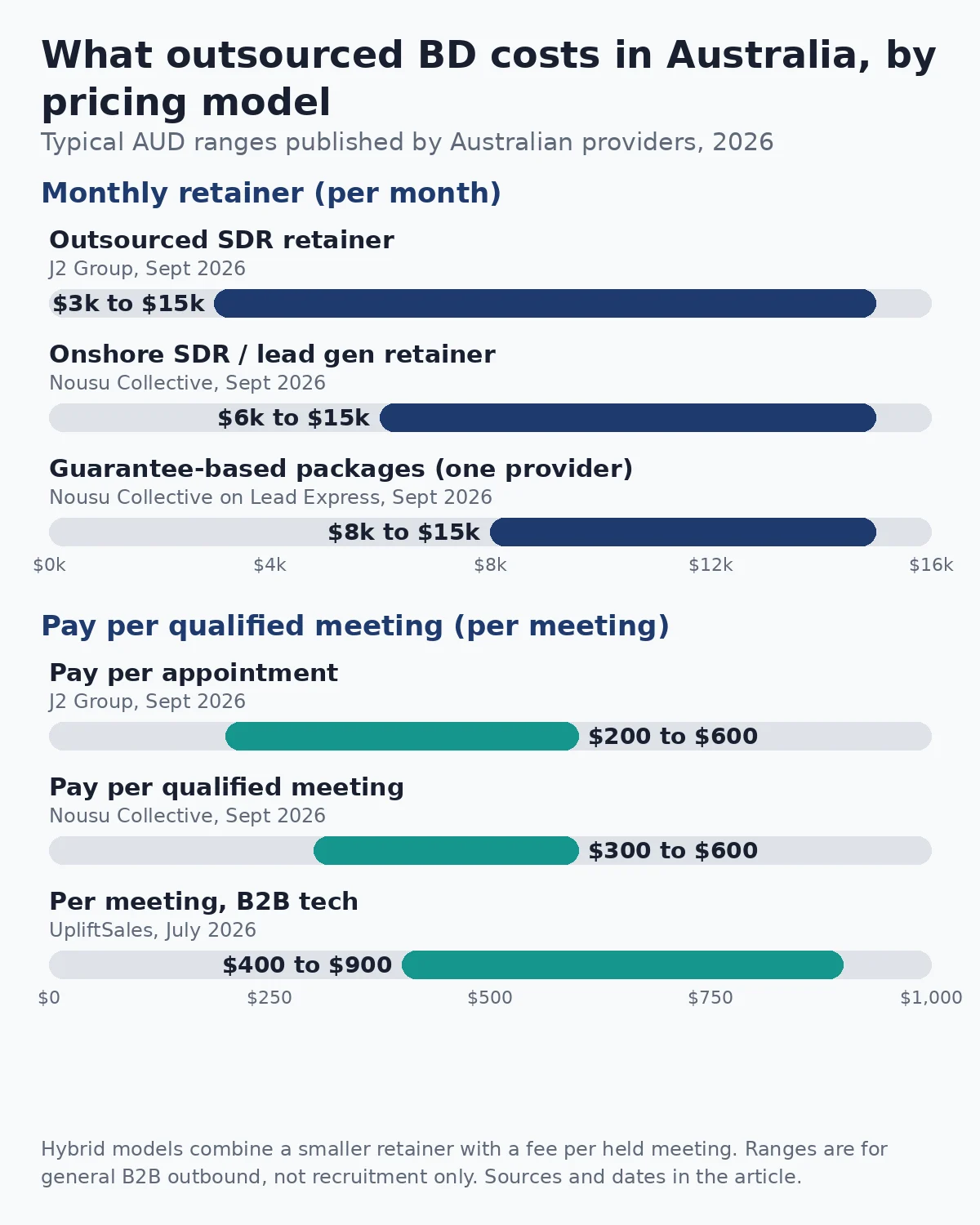
A broader market table from Telemarketing Professionals (6 August 2026) puts multi-channel prospecting at $4,000 to $15,000+ a month and a dedicated SDR at $5,000 to $12,000.
A few things to know before you compare quotes:
- Most of these figures aren't recruitment-specific. They're for B2B outbound in general, and much of it is phone-led selling to tech companies. In our experience, email-led campaigns aimed at a single recruitment niche usually sit toward the lower end of the retainer range.
- Pay per meeting sounds safer than it is. It works when "qualified" is defined tightly in writing. When it isn't, you pay for calendar entries with people who were never going to brief you.
- Guarantees vary a lot. Some guarantee meetings, some guarantee leads, and some guarantee nothing measurable. Read what's counted.
Where does CLCK sit? We use a guarantee-based retainer: 20 interested employers in your first 90 days, or we keep working for free until you hit that target. For where our campaigns start, see our recruitment lead generation page. Your exact price comes on the planning call.
What's usually included, and what drives the price
A full outbound campaign for a recruitment agency normally covers:
- choosing the niche and the employers who fit it
- finding the right hiring managers and their contact details
- writing the emails and follow-ups
- sending from separate domains, so your main inbox stays safe
- reading replies and passing on the interested ones
- reporting, testing and refining
Ask what's inside the fee and what's billed on top. J2 Group notes that a $5,000 monthly figure can climb to $9,000 once data, onboarding and tooling are added back in.
These are the things that move the price up or down:
- Niche size. A small niche (say, aged care operators in regional Queensland) needs fewer contacts and less data than a national search across several industries.
- Channels. Email alone costs less than email plus phone plus LinkedIn. Calling time is the most expensive part of most campaigns.
- Data. Verified hiring-manager contacts cost money. Cheap lists cost you later in bounces and spam folders.
- Copy and testing. Personalised emails written for one niche take more work than one template sent to everyone.
- Reply handling. Someone has to read every reply, filter out the noise and pass on the good ones the same day. Cheaper offers often skip this part.
- Sending setup. Separate sending domains and warm-up protect your main domain's reputation. We send in your agency's name from separate sending domains for this reason.
The in-house BDM alternative (an estimate)
Hiring a business development manager is the obvious alternative. Here's a rough first-year cost, built from current public figures.
| Cost line | Estimate (AUD a year) | Source |
|---|---|---|
| Base salary | $104,255 | Indeed, average BDM salary in Australia (updated 5 Oct 2026) |
| Super at 12% | $12,511 | ATO super guarantee rate, 12% from 1 July 2025 |
| Tools (CRM, data, sending, dialler) | $12,150 to $25,800 | UpliftSales tools table (11 July 2026) |
| Total before commission and recruitment | $128,916 to $142,566 | Our sum of the lines above |
This is an estimate. Indeed's average covers BDMs across every industry, not recruitment only. It leaves out commission, payroll tax where it applies, the cost of hiring the person and the time you'll spend managing them. Add those in and it climbs. UpliftSales puts the fully loaded cost of an in-house appointment setter at $148,000 to $226,000 a year.
Then there's ramp. A new hire usually takes 3 to 6 months to reach full output (UpliftSales; J2 Group says 3 to 4 months). You pay the full salary from day one, and when that person goes on leave or moves on, your BD stops.
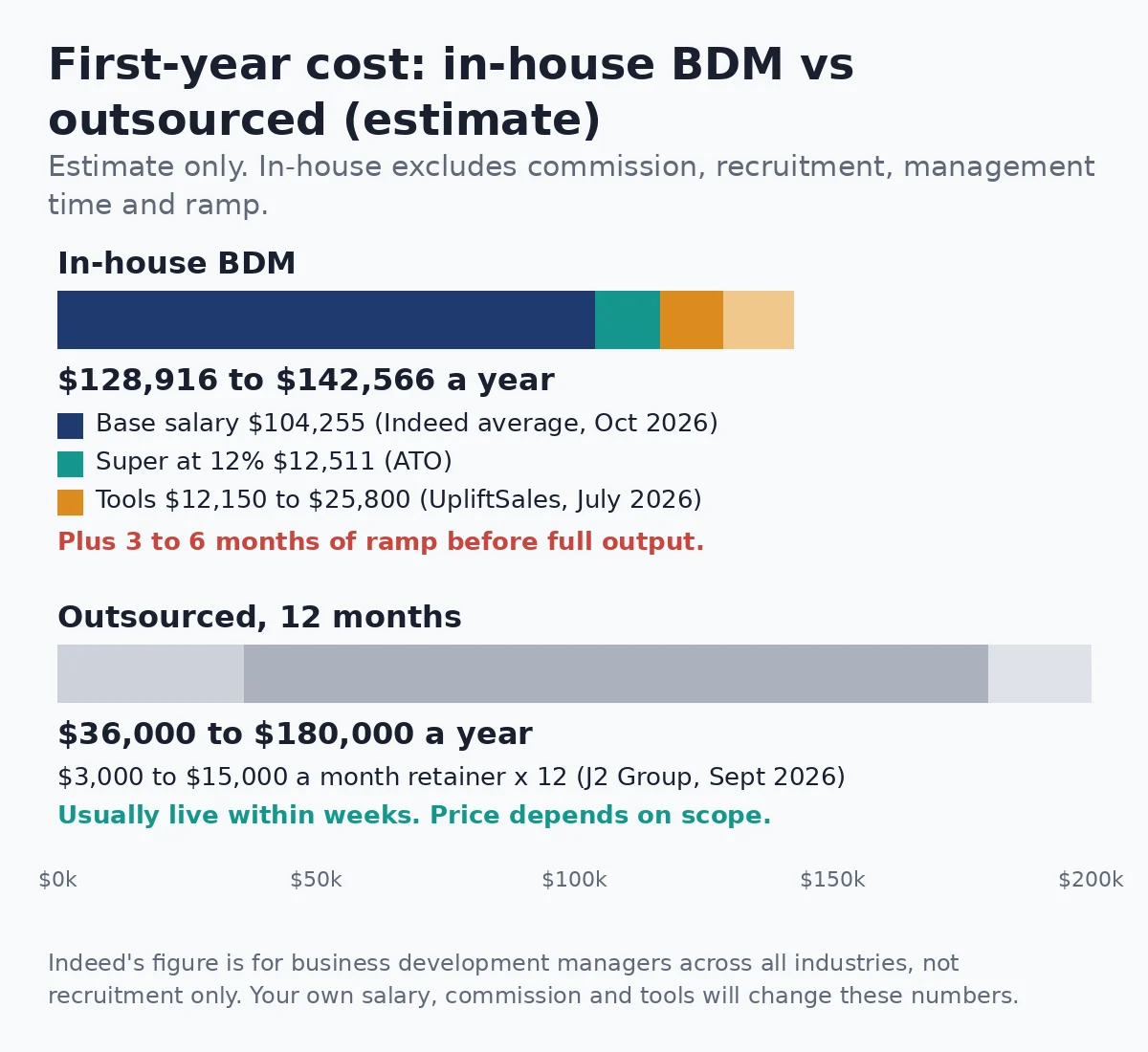
A BDM can still be the right call. If you want someone who also runs client meetings, builds relationships in person and wins work, outsourced outreach won't replace that. Outsourcing covers the part that eats the most time: finding employers, emailing them every week, following up and reading replies.
A worked payback example, using placement fees
Recruitment has one big advantage when you do the maths: a single placement is worth a lot. Here's an example.
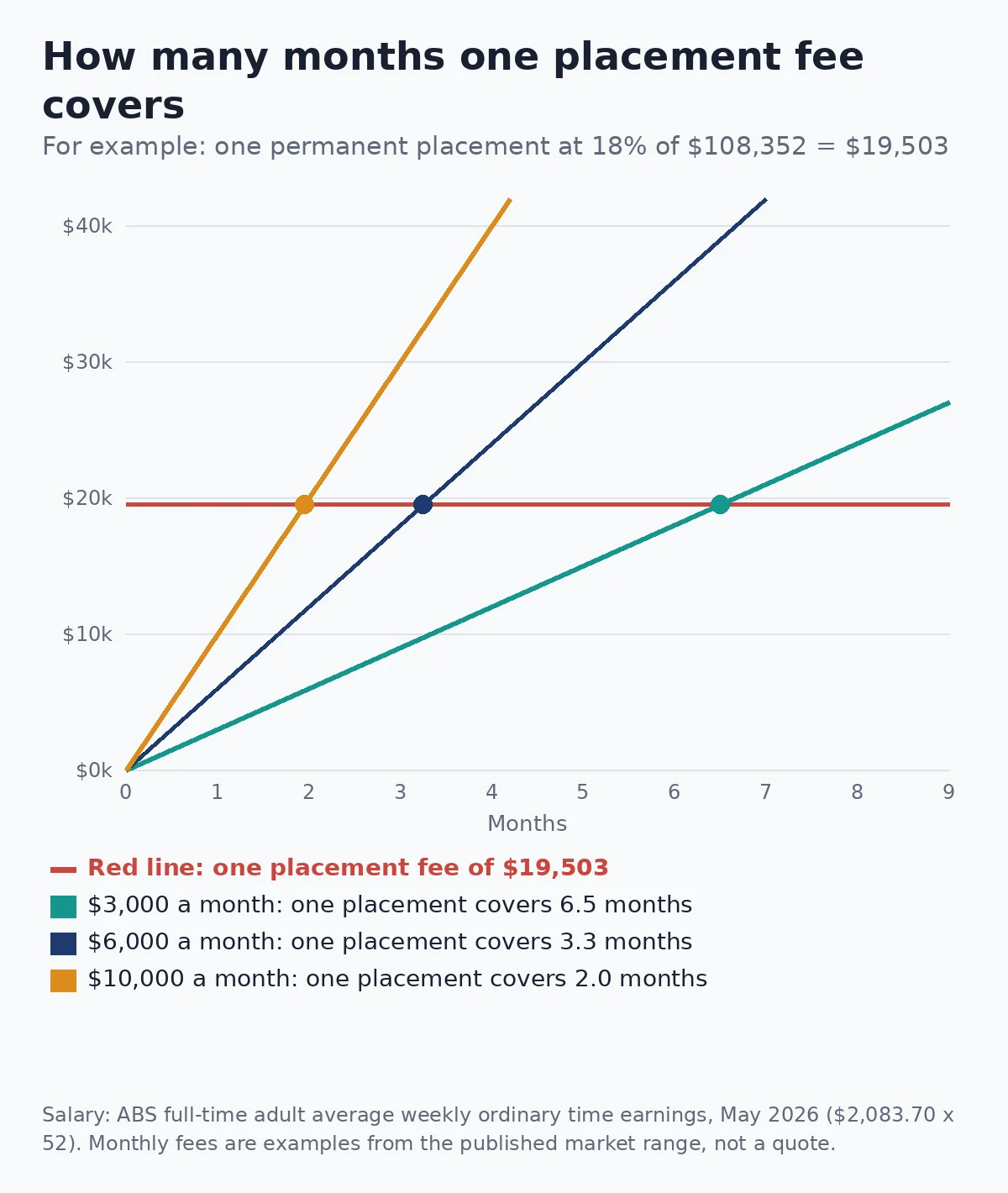
For example, take a permanent placement at the average full-time salary and an 18% fee:
- Salary: $2,083.70 a week (ABS average full-time ordinary time earnings, May 2026) x 52 = $108,352
- Fee: $108,352 x 18% = $19,503 for one placement
Now compare that fee with a monthly campaign cost:
- At $3,000 a month, one placement covers 6.5 months.
- At $6,000 a month, it covers 3.3 months.
- At $10,000 a month, it covers 2 months.
That's why we say one placement at an average fee usually covers the first 3 to 6 months of a campaign.
Now carry it through. For example, using the defaults in our calculator at recruitment.clck.au:
- 20 interested employers in 90 days (our guarantee)
- 50% take a meeting: 20 x 50% = 10 meetings
- 20% of meetings become clients: 10 x 20% = 2 new employer clients
- Each client gives you 3 roles in year one: 2 x 3 = 6 placements
- 6 x $19,503 = $117,018 in fees, before consultant commission
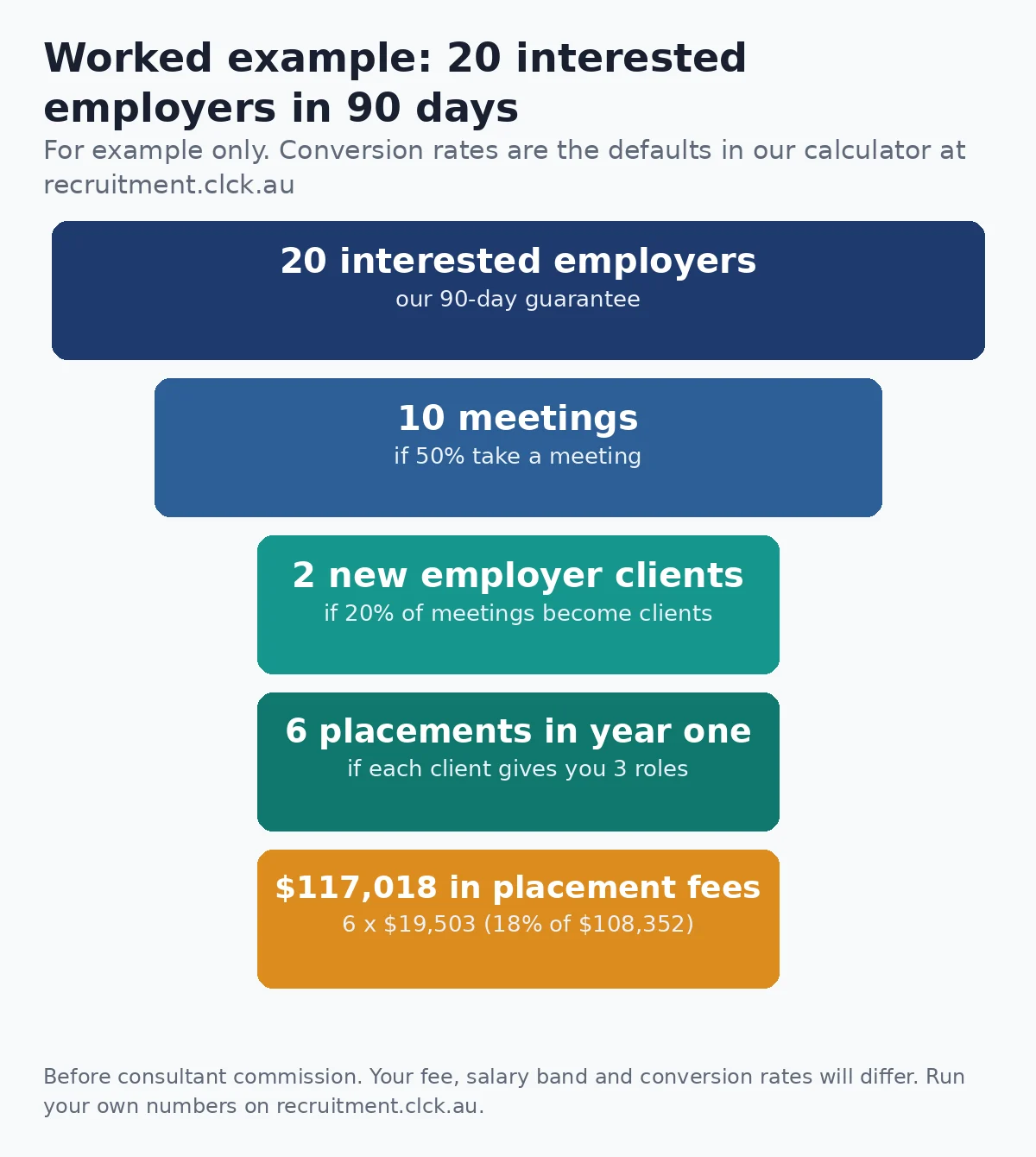
Your numbers will differ. Your fee may be 15% or 25%, your roles may pay more or less, and your team's close rate matters more than anything we do. Change the inputs on the calculator to see your own version.
Real results vary too. One recruitment firm we work with signed 6 new clients in 15 days from its first 20 positive replies, and 10 in total. Across four 2026 campaigns, another recruitment client heard from 96 interested employers.
"Within the first month of our first campaign, I started securing clients."
Questions to ask a provider before you sign
- What exactly counts as a result? Get the definition in writing. We count an employer as interested when a decision-maker asks to talk, asks about candidates or fees, or sends you a role. Out-of-office and "not now" replies don't count.
- What's in the fee, and what's extra? Data, sending domains, copywriting, reply handling and reporting should all be named.
- Whose name do the emails go out under? If it's yours, ask how your main domain is protected.
- Who reads the replies, and how fast do interested ones reach you? A hot reply that sits for two days goes cold.
- How long is the minimum term? Three months is common (it's our minimum too) because the first month is mostly setup and ramp.
- What happens if the target isn't met? Free months, a refund, or nothing?
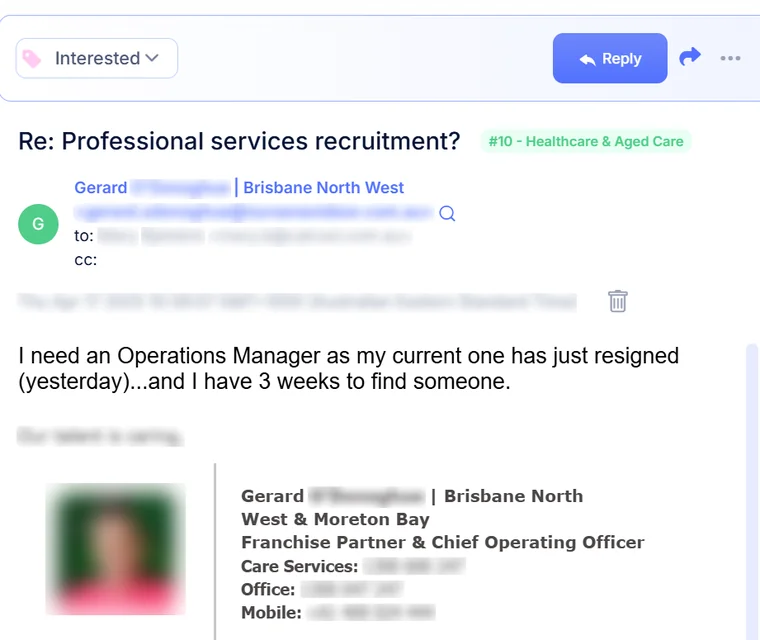
- Can you show real replies from recruitment campaigns? Screenshots with names blurred are fine. Vague case studies aren't.
- Is my niche big enough? A good provider checks this before taking your money.
When outsourcing isn't worth it
Outsourced BD won't help every agency. It's probably not worth it if:
- Nobody can call back interested employers the same day. The campaign finds the conversations. Your team still has to win the work.
- Your niche is tiny. If there are only a few dozen employers who could ever use you, a personal approach from the director will beat a campaign.
- You already have the time and someone who enjoys prospecting. Doing it yourself is cheaper. Recruitment BD software such as Kolvera starts at A$99 a month (as listed on its pricing page) if you want tools rather than a service.
- You want a spreadsheet of names to call yourself. That's a data purchase, and much cheaper.
- You need guaranteed placements. No outreach provider can honestly promise those. We guarantee interested employers, and your team does the rest.
FAQs
How much does outsourced lead generation cost for a recruitment agency in Australia?
Usually $3,000 to $15,000 a month on a retainer, or about $200 to $600 per qualified meeting, based on Australian providers' published 2026 pricing. In our experience, email-led campaigns aimed at one niche tend to sit at the lower end.
Is it cheaper to hire a BDM or outsource?
Across most of the published range, outsourcing costs less in the first year. Our estimate for an in-house BDM is about $129,000 to $143,000 a year before commission and recruitment, plus 3 to 6 months of ramp. A BDM does more than outreach, though, so compare the work you actually need done.
What's the difference between a retainer and pay per meeting?
A retainer is a fixed monthly fee for running the campaign. Pay per meeting charges for each qualified meeting booked. Pay per meeting only works when "qualified" is clearly defined in the contract.
How long before outsourced BD pays for itself?
It depends on your fee and close rate. For example, one permanent placement at an 18% fee on an average full-time salary is about $19,500, which covers 3 to 6 months of a campaign costing $3,250 to $6,500 a month.
How long is the usual contract?
Three months to start is common, then month to month. Ours works that way, because it takes about three months to set up, test and learn what works in your niche.
Does CLCK publish its price?
Yes. See our recruitment lead generation page for where our campaigns start. Your exact price depends on your market and scope, and you'll get it on the planning call.
Find out what it would cost for your niche
Apply for a free planning session. Before the call, we'll research your market, so you'll see how many hiring managers in your niche we could reach and what it would cost.