

Yes, cold email can win new employer clients for a recruitment agency. We've watched it happen in our own campaigns. It also fails for plenty of agencies, and when it does, the cause is almost always the same handful of things.
If you run a small agency, you've probably been on both sides of this. You've had a month where every desk is full, then a month where you're wondering where the next brief is coming from. And you've probably deleted a hundred cold emails yourself.
So here's our honest answer: when cold email works for recruiters, when it doesn't, and what makes the difference.
Why cold email suits recruitment in the first place
Most small agencies win clients through referrals and word of mouth. That's great when it's flowing. The trouble is you can't make a referral turn up when you need one.
The other problem is time. When roles are live, business development is the first thing to go. You're flat out filling jobs, nobody's out finding the next client, and then the roles are filled and the pipeline's empty.
Cold email fixes both, because it keeps running when you're busy. It also lets you reach employers before they advertise. Once a role hits the job boards, every agency in town is calling that hiring manager. The employers who'll hire next quarter are much quieter, and almost nobody is talking to them.

A short, well-aimed email lets you start that conversation early, in your agency's name, without picking up the phone.
When cold email works for recruiters
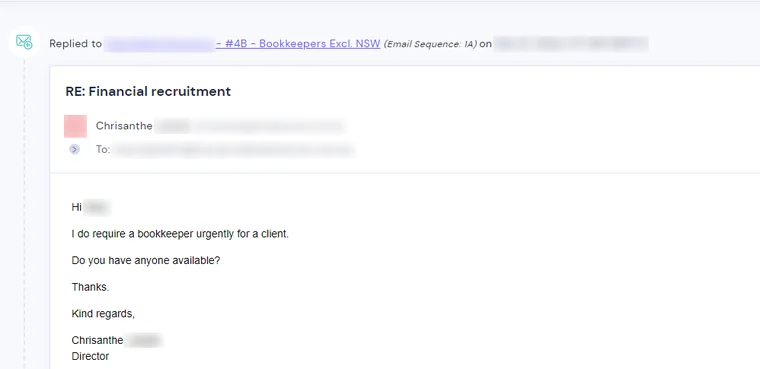
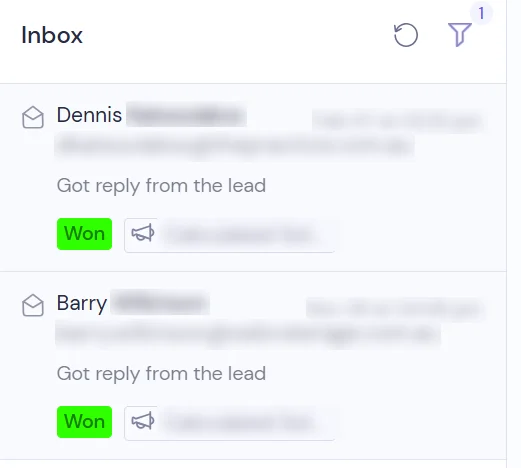
Here's what it looks like when it's working. These are real replies from employers to recruitment campaigns we've run. Names are blurred.
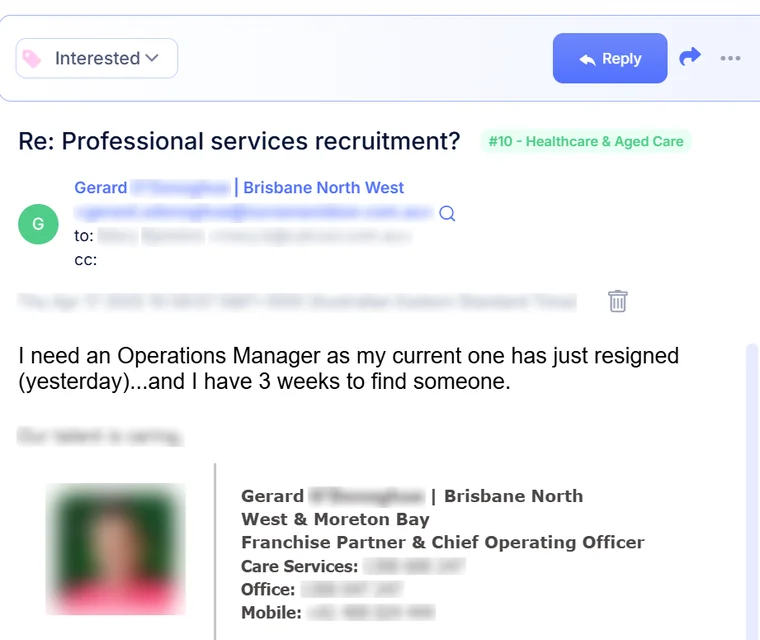
None of these people were advertising when the email arrived. They had a problem, the email was about that problem, and it came from someone who looked like they knew their world.
In our experience, cold email works for recruitment agencies when four things line up:
- A clear niche. You place a specific type of person, so you can name the employers who hire them.
- The right person gets the email. The hiring manager or owner who feels the pain of an empty seat.
- Someone calls back the same day. An employer who replies today and hears back next week has usually found someone else.
- You give it three months. The first month is about sending and learning. In our experience, the second and third months are where you refine and the replies build.
When those are in place, the results can be good. For one recruitment client, four 2026 campaigns produced 96 interested employers. Another recruitment firm signed 6 new clients in 15 days from 20 positive replies, and 10 clients in total from that campaign.
Mary B., Managing Director of Calculated Solutions, a financial services recruitment agency, put it this way: "Within the first month of our first campaign, I started securing clients."
When cold email fails
Most recruiters who say cold email doesn't work have tried it once and been burnt. The reasons are nearly always the same.
The list is wrong. A bought list of "HR managers in Sydney" gets you people who don't hire for your niche, don't make the decision or left the company a year ago. Every one of those is a wasted send.
The email reads like a pitch. Long paragraphs about your agency, a list of sectors, an attached candidate profile nobody asked for. Busy owners delete these in a second. The emails that get replies are short, plain and about the employer's roles.
It lands in junk. Since February 2024, Google has required anyone sending to Gmail addresses to authenticate their domain and keep spam complaints low, and mail that doesn't meet the rules can be marked as spam or rejected. Send a burst of cold email from a fresh inbox with no setup and you'll find out quickly. Worse, if you send it from your agency's main domain, you can drag down delivery of your everyday email to candidates and clients.
Replies sit there. An interested employer emails back on a Tuesday and nobody notices until Friday. By then the moment has gone.
You measure the wrong thing. Open rates and "meetings booked" can look healthy while nothing turns into work. Meetings with the wrong people waste your time and your money.
It stops after a month. One month of sending, a couple of replies, a decision that it "doesn't work". Cold email builds on what you learn, and the first month is the least informative.
What makes the difference
Put the working and failing campaigns side by side and the gap comes down to care at each step.
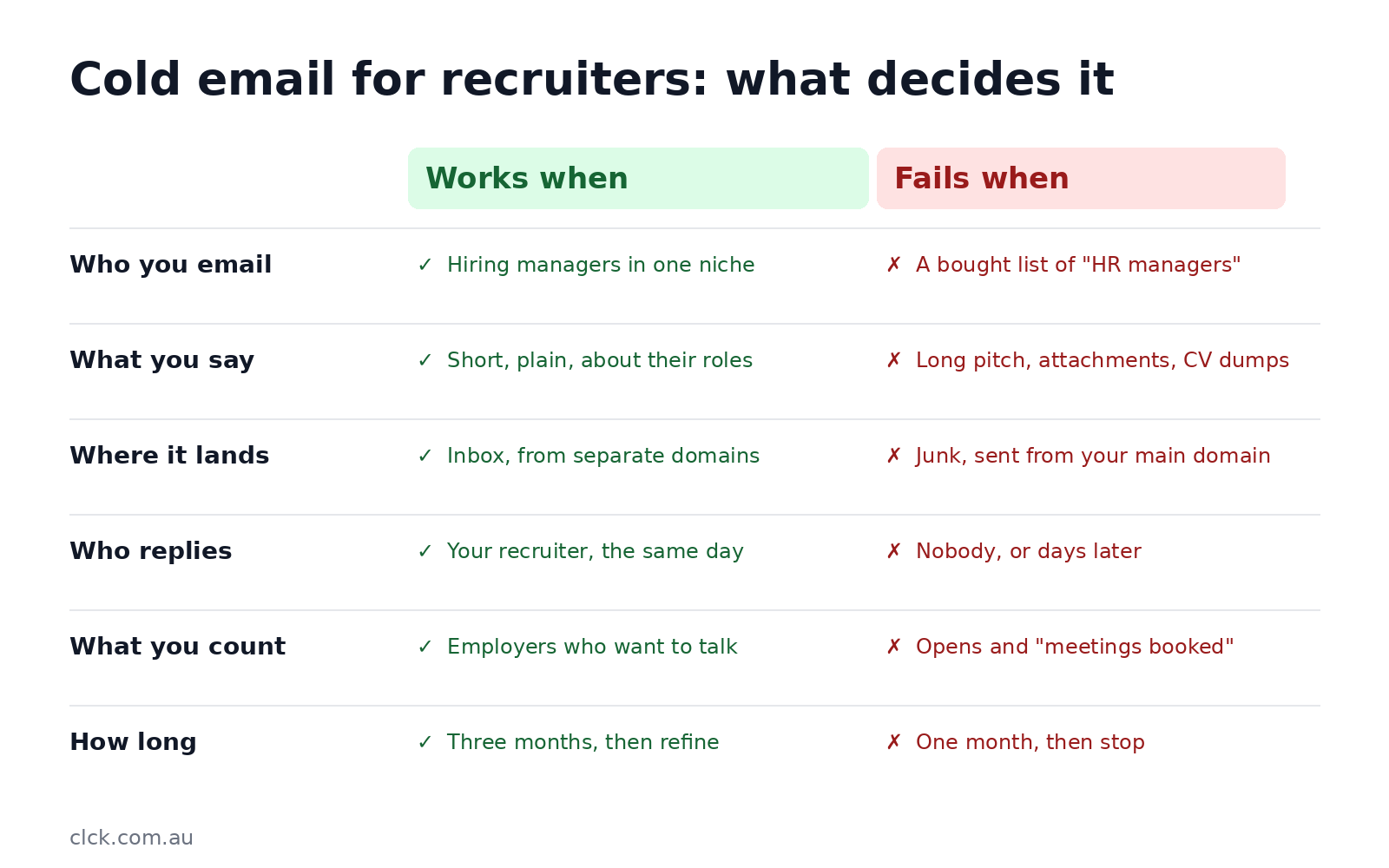
Here's how we approach each part.
Pick one niche and one offer
We start with the roles you place best and the employers who hire them. That sharp focus is what lets the email sound like it came from someone who knows the industry. A campaign that tries to cover accounting, aged care and logistics at once sounds like it came from nobody in particular.
Find the actual hiring managers
We research the decision-makers in your niche: owners, directors and the managers who carry the vacancy. It's slower than buying a list, and it's the main reason replies come back from people who can actually give you a role.
Write short, plain emails in your agency's name
Each employer gets three short emails. They sound like a recruiter writing to a hiring manager, because that's what they are. No attachments, no long agency bios, one easy question to reply to.
Protect your main domain
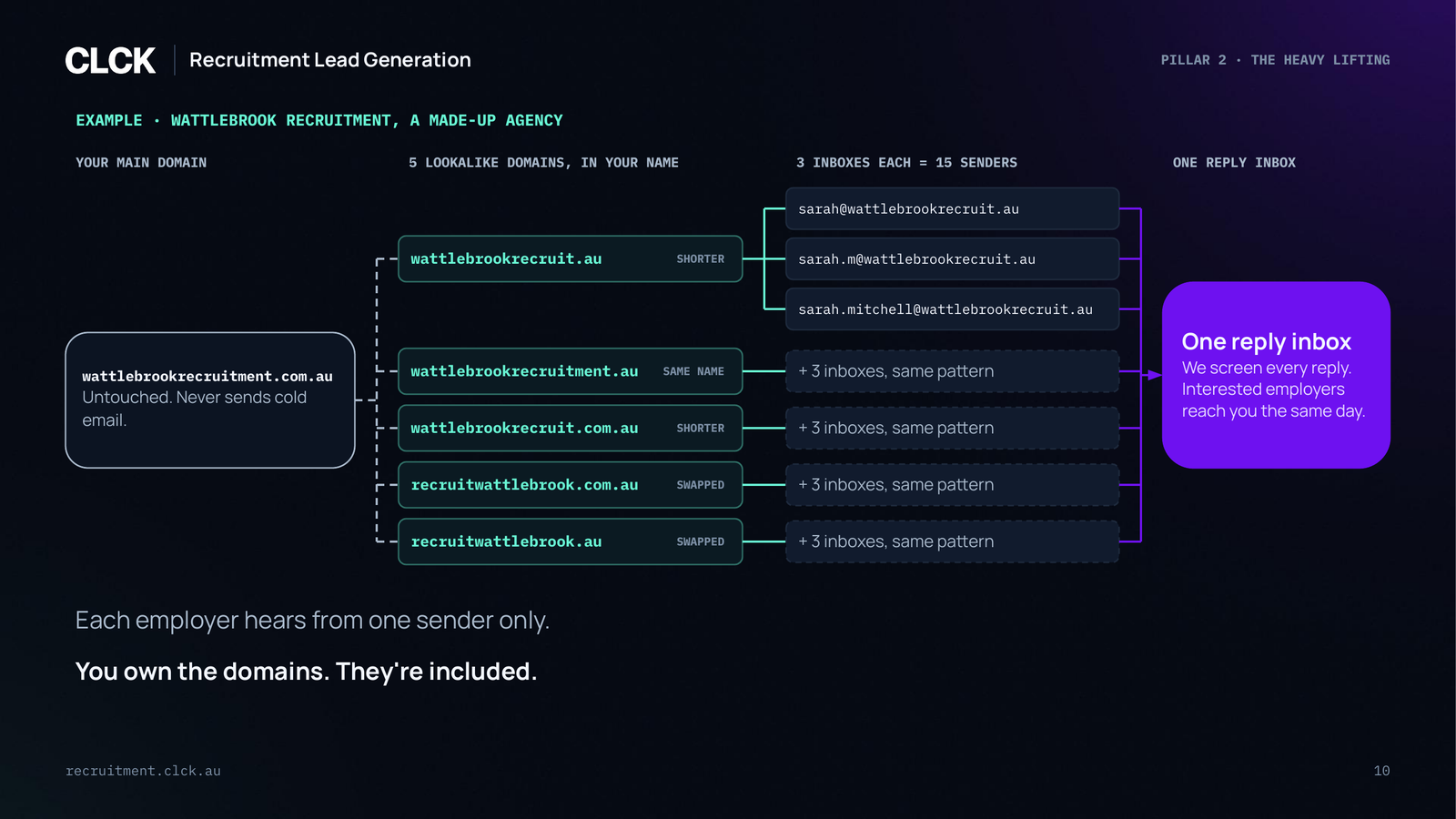
Our campaigns send from separate domains set up in your agency's name, so your main domain never sends cold email. We set up and warm up each domain and inbox before it sends.
Stay on the right side of the Spam Act
In Australia, commercial email is covered by the Spam Act 2003. Consent can be inferred when a business email address is conspicuously published, there's no statement saying the person doesn't want unsolicited messages, and your message is relevant to their role. Every message also needs to identify your business, include your contact details and offer an easy way to unsubscribe that you honour within 5 working days. Get advice on your own situation, and treat these rules as the floor.
Count interested employers, then follow up fast
We only count an employer as interested when a decision-maker asks to talk, asks about candidates or fees, or sends you a role. Out-of-office replies, "not now" and unsubscribes don't count. Every interested reply goes straight to your team. Call back the same day if you possibly can.
Is it worth it for a small agency?
Run the numbers on one new client. One placement at an average fee usually covers the first 3 to 6 months of a campaign, and a good employer client rarely hires just once.
That's why we're comfortable putting a guarantee on it. We guarantee 20 interested employers in your first 90 days, or we keep working for free until you hit that target. We'll give you the exact price on a planning call once we've looked at your niche. It's three months to start, then month to month.
Cold email won't suit every agency. If you don't have a clear niche, or nobody can call back an interested employer the same day, fix that first. If you do, it's one of the most reliable ways we know to keep new employer conversations coming in while you're busy filling roles.
Next step
If you'd like to know how many hiring managers in your niche we could reach, apply for a free planning session. It takes about a minute, then you pick a time for your call.