
LEAD GENERATION
Is cold email still effective for B2B lead generation in Australia?
Yes. Cold email still works for B2B lead generation in Australia when it goes to a tight list of the right people, carries an offer that's relevant to their role, is sent from properly set-up inboxes and gets a quick, thoughtful reply from your team when someone responds. What has stopped working is volume: bought lists, generic templates and thousands of emails sent from your main business domain.
Set your expectations by the numbers. Large platform studies put the average cold email reply rate at around 3 to 5% of the people contacted, and most of those replies aren't a yes. In Australia, cold email also has to follow the Spam Act 2003, which permits unsolicited B2B email to a business address only in limited circumstances. Whether it works for your business comes down less to the channel and more to whether your targeting, offer, reply handling and follow-up in the CRM are joined up.
We run cold email and LinkedIn outreach for Australian B2B businesses, so we have a view. This guide covers what changed, what a realistic result looks like, the rules you need to follow and what has to be in place for the replies to turn into customers.
What changed for cold email?
Two things: the inbox providers got stricter, and buyers got less patient with generic outreach.
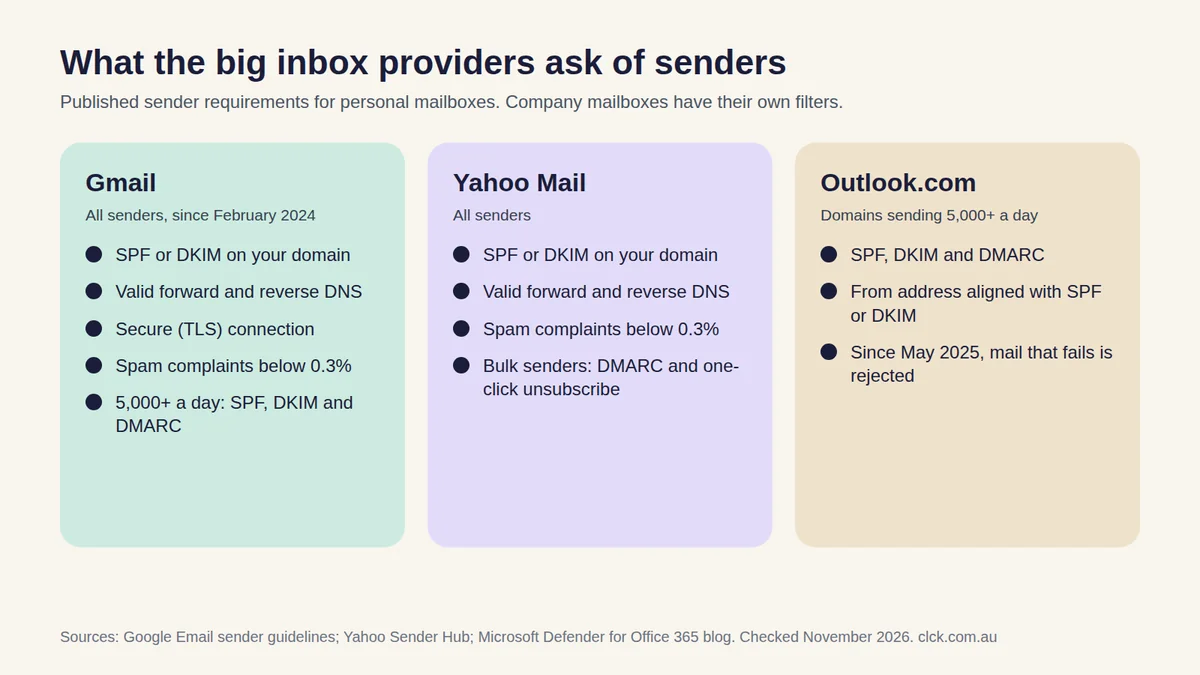
On the provider side, Google, Yahoo and Microsoft have all published sender requirements since 2024.
| Provider | Who it applies to | What it asks for |
|---|---|---|
| Google (Gmail) | Everyone sending to personal Gmail accounts, since February 2024 | SPF or DKIM authentication, valid DNS records, a secure connection and spam complaints below 0.3%. Senders of more than 5,000 messages a day also need SPF, DKIM and DMARC. |
| Yahoo | Everyone sending to Yahoo Mail | SPF or DKIM and spam complaints below 0.3%. Bulk senders also need DMARC and one-click unsubscribe. |
| Microsoft (Outlook.com, Hotmail, Live) | Domains sending more than 5,000 messages a day | SPF, DKIM and DMARC. Since May 2025, mail that fails is rejected. |
SPF, DKIM and DMARC are records on your domain that prove an email really came from you. Those rules are written for personal inboxes, and most B2B email goes to company mailboxes with their own filters. Even so, they show where the big providers have drawn the line, and a setup that fails them is unlikely to do well anywhere.
On the buyer side, the people you're emailing have told researchers what puts them off. In Hunter's 2026 survey of decision-makers, 65% said cold emails fail because they feel too sales-focused and 61% pointed to emails that weren't relevant to them. The same survey found 58% still receive a cold email worth reading at least once a month. There's still an audience for a good cold email, and less patience than ever for a lazy one.
What's a realistic cold email reply rate?
For most B2B campaigns, a reply rate of 3 to 5% of the people contacted is normal. Above about 5.5% puts you in the top quarter of senders on Instantly's figures. Here's what the larger published studies report:
- Hunter analysed 31 million emails sent in 2025 and found an average reply rate of 4.5% per sequence, or 45 replies for every 1,000 people contacted. Sales outreach averaged 3%.
- Instantly puts the average at 3.43% across its users, with the top quarter of senders above 5.5% and the top 10% above 10%.
- Belkins reports 0.45% for 2025, because it divides replies by every email sent, including follow-ups, rather than by people contacted.
That last figure shows why benchmarks disagree. The same campaign can report very different reply rates depending on what it divides by. All three studies are global and mostly North American. We haven't found a published benchmark for Australian B2B cold email, so treat these as a rough guide.
A reply rate also counts every out-of-office, "not interested" and unsubscribe request. Hunter notes that most replies are negative. The numbers that matter are further down the line: interested replies, meetings, opportunities and customers.
Here's one of our campaigns, from our B2B lead generation page. A lead-management software business contacted 338 targeted people. That produced 98 replies, of which 37 were interested. Those conversations turned into 15 booked meetings and four new clients within the first 40 days.
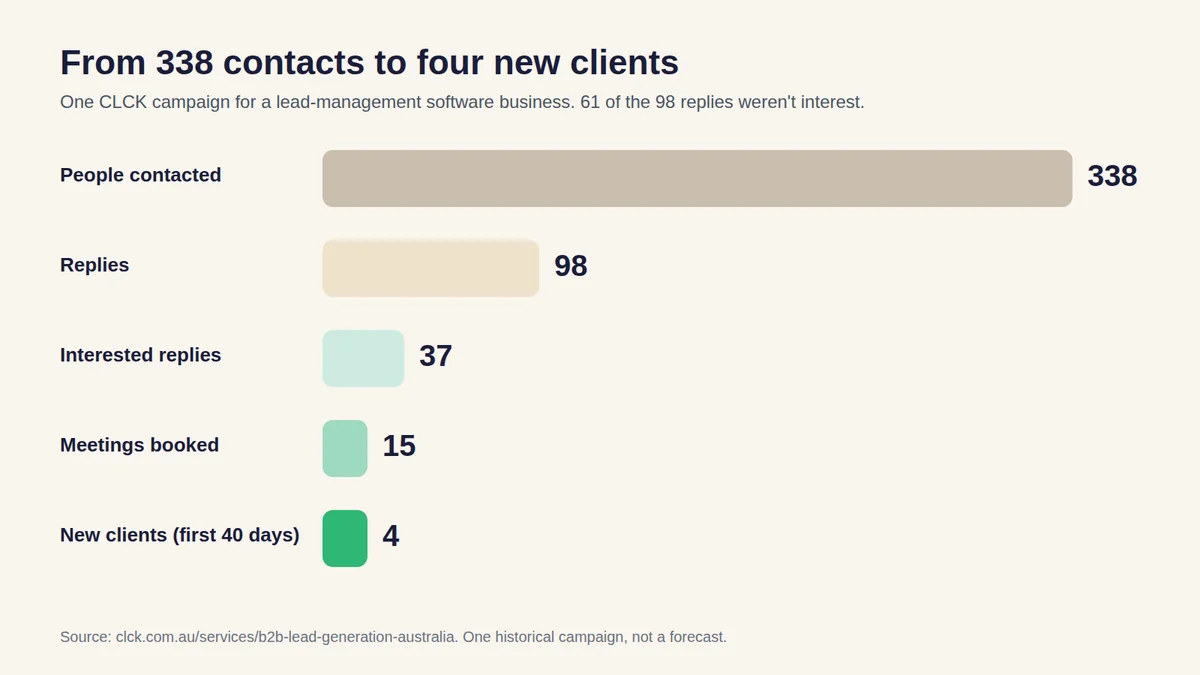
Judged on replies alone, that campaign would look like 98 wins. In fact 61 of those replies weren't interest at all: an out-of-office or a polite "no thanks" isn't a sales opportunity. The four clients came from connecting the work: who to contact, why they'd care, how to follow up and what to do when they replied.
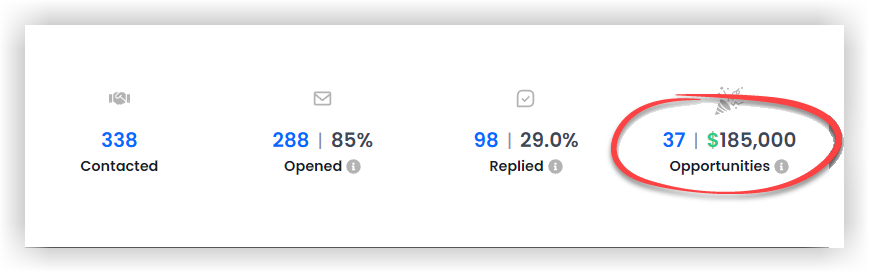
That campaign's dashboard showed a 29% reply rate and $185,000 in pipeline in under 60 days. Pipeline is potential business, not revenue received, which is why the interested replies, meetings and clients are the figures to watch.
Other campaigns on our cold email page show the same pattern at different stages: 18 interested prospects turned into six confirmed proposals in 15 days, and a commercial cleaning campaign signed four new clients worth more than $100,000 in contracts. These are separate historical campaigns, not averages or forecasts.
Who does cold email work best for?
Cold email tends to work when most of these are true:
- You can name your market. You know the industries, company sizes and roles you want to reach, and there are enough of them to contact.
- Your offer solves a problem buyers recognise. The reader can tell within a few lines why it might matter to them.
- Each new client is worth enough. A higher-value sale gives a campaign room to cover the setup, data and time involved.
- Someone can respond quickly. An interested reply needs an answer from a person who can move the conversation forward, ideally the same day.
It's a weaker first channel when buyers need to know and trust you before they'll reply, when you sell to consumers, or when nobody has time to follow up. If trust has to come first, LinkedIn may lead. Hunter's survey found 50.5% of decision-makers now prefer to be approached on LinkedIn, compared with 25% for email, which raises the bar for any email you send. Our comparison of LinkedIn and cold email for B2B service businesses helps you choose, and hybrid outbound covers using both.
What makes cold email work?
When a campaign fails, it's usually because one part is weak, even if the others are fine. A well-written email goes to the wrong list. The right list hears from an inbox that lands in spam. Good replies come in and nobody answers them for three days. Cold email works when these parts are run as one process.
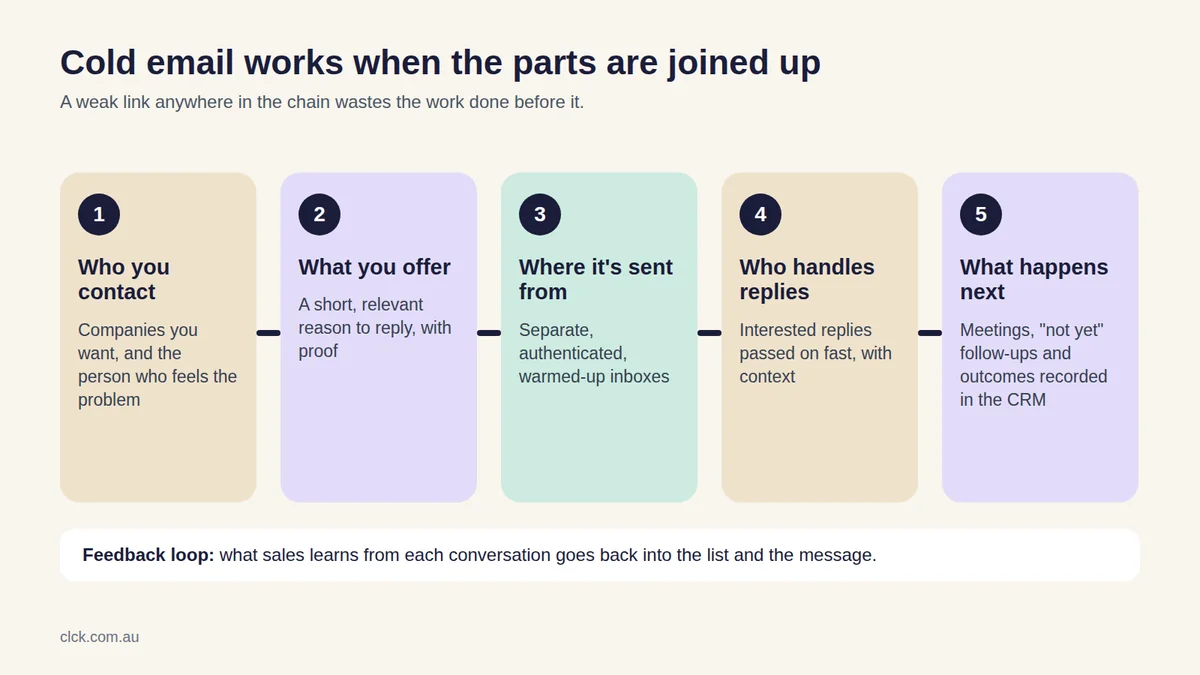
Who are you contacting?
Start with the companies you'd want as clients and the person in each who feels the problem you solve. A short list of good fits beats a long list of loose matches. Hunter's data backs this up: campaigns sent to 21 to 50 people averaged a 6.2% reply rate, compared with 2.4% for campaigns sent to more than 500. Emailing one or two people at a company also did better than emailing three or more.
That doesn't mean you can only contact 50 people. It means splitting a larger market into small groups that share a problem, so each message can be written for that group.
What are you offering, and why would they reply?
The email has to give a busy person a reason to answer. That usually means a short message about their situation, one piece of relevant proof and one easy question. A pitch about your company, a list of services or an attachment nobody asked for gets deleted.
Follow-ups matter too. In Hunter's data, sending three messages instead of one roughly doubled the replies, while sequences that kept going past that point averaged lower reply rates. A few well-spaced, relevant follow-ups give the right buyer more chances to respond without wearing out your welcome.
AI can help research companies and adapt an approved message to different groups. It can't make a weak offer persuasive, and 69% of the decision-makers in Hunter's survey said it bothers them when AI was used unless the email feels genuinely human. We use AI for research and drafting, decide the audience, offer and proof with you, and review samples before anything goes live.
Where is it being sent from?
Cold email shouldn't go out from your main business domain. We send managed campaigns from separate domains and inboxes, warm them up gradually and monitor delivery, so the domain your clients and suppliers rely on isn't carrying the campaign. That reduces the risk. It doesn't remove it, and no honest provider can promise inbox placement.
Send from a proper business domain, never a free email account. In Hunter's data, emails from custom domains got more than twice the reply rate of emails from free accounts (5.2% against 2.5%).
What happens when someone replies?
This is where many campaigns lose the value they've created. Someone should read every reply, sort the interested ones from the rest and pass them on quickly with the context: who they are, what they said and what they want next. A buyer who replies on Tuesday and hears back on Friday has often moved on.
Agree in writing what counts as an interested reply and a qualified meeting before you start. If you don't, a campaign can look busy while producing little. We cover that in why outbound lead generation books unqualified meetings.
What happens to the prospects who say "not yet"?
Plenty of good prospects reply with "not right now" or "talk to me next quarter". Those replies are worth more than they look, as long as someone records them in the CRM with a follow-up date and a reason. Otherwise they sit in an inbox and the campaign pays for the same conversation twice. Our article on what to send a lead who isn't ready yet covers the follow-up.
You don't need a particular CRM for this. HubSpot is one option, and we work with others or with no CRM at all. What you need is a reliable record of who replied, what they said and who owns the next step. If leads already go missing between first contact and follow-up, fix that before adding volume. Our guide on when to fix HubSpot before scaling lead generation shows the warning signs, and they apply to any CRM.
Is cold email legal in Australia?
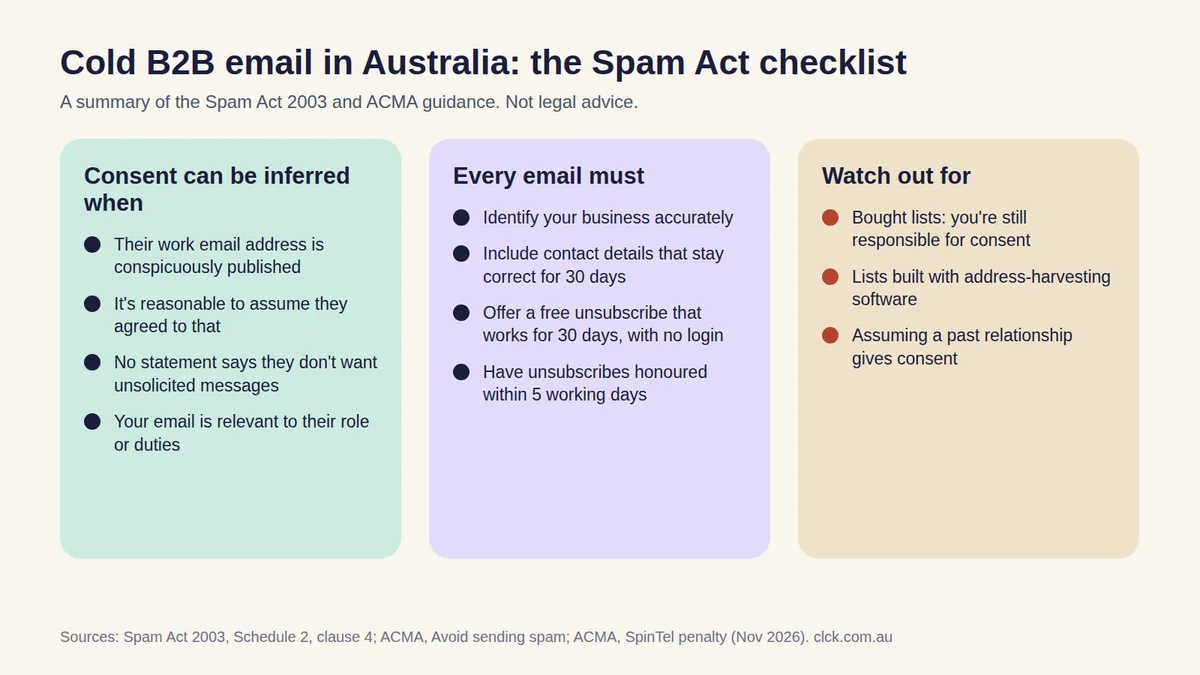
Yes, within the Spam Act 2003, which the Australian Communications and Media Authority (ACMA) enforces. Commercial email needs consent. For cold B2B email, the Act lets you infer consent when someone's work email address has been conspicuously published, it's reasonable to assume it was published with their agreement, there's no statement saying they don't want unsolicited commercial messages, and your email is relevant to their work role or duties. Publication alone isn't enough.
Every commercial email also has to:
- identify your business accurately, with contact details that stay correct for at least 30 days
- include a plainly worded way to unsubscribe that's free, works for at least 30 days and doesn't require a login
- have unsubscribe requests honoured within five working days
ACMA also makes two points that matter for cold email. If you buy a list, you're still responsible for having consent for every address on it. And using or supplying a list built with address-harvesting software breaks the rules.
ACMA does enforce this. In November 2026 it announced that telco SpinTel had paid a $653,400 penalty for sending more than 32,000 marketing emails without consent. SpinTel argued it could infer consent from a past customer relationship, and ACMA said a previous relationship didn't automatically provide consent. ACMA also reported that businesses had paid more than $11 million in spam penalties over the previous 18 months. That case involved consumers rather than B2B outreach, but the lesson carries across: a weak reason for inferring consent won't hold up.
This is a summary, not legal advice. Check ACMA's guidance on avoiding spam for the detail and get advice on your own situation.
Does cold email work for recruitment agencies?
It can. Recruitment is one of the markets where we see cold email work well, because agencies can reach employers before roles are advertised. Campaigns for Careers in Demand, an education and VET recruiter, reached 96 interested employers and led to eight placements. The same rules apply: a defined niche, the right hiring manager and a same-day call back. Our article on whether cold email works for recruitment agencies covers it in detail.
How long does cold email take to work?
Setup and warm-up for our managed campaigns typically take around 10 to 15 business days. After that, the first few months are mostly list testing, inbox care, learning which messages land and handling replies. How quickly replies turn into revenue then depends on your sales cycle.
Frequently asked questions
Is cold email the same as spam?
No. In Australia, spam is commercial email sent without consent or without the required sender details and unsubscribe option. A relevant email to a conspicuously published business address, sent in line with the Spam Act, is legal. Many people still call any unwanted email spam, which is another reason to keep your list tight and your message relevant.
What's a good cold email reply rate in Australia?
There's no published Australian benchmark that we know of. Global studies put the average at around 3 to 5% of people contacted, with top performers above 10%. Judge your campaign on interested replies, meetings and customers rather than total replies.
Should we send cold email from our main domain?
We don't recommend it. Use separate sending domains and inboxes that are authenticated and warmed up, so a problem with the campaign doesn't affect your everyday email.
Is LinkedIn better than cold email?
It depends on how your buyers decide. LinkedIn tends to suit sales where trust and recognition come first. Cold email suits a defined market with a direct offer. Some businesses use both in a planned sequence.
Do we need a CRM before starting cold email?
You need somewhere to record who replied, what they said and the next step. That can be HubSpot, another CRM or, at the very start, a simple shared record. What matters is that interested and "not yet" replies don't get lost.
Next step
If you're deciding whether cold email is worth trying, start with three questions: can you name the companies you want, would they care about your offer, and can your team respond quickly when they reply? If you'd like a second opinion on your market, your offer and how the replies would be followed up, book a strategy session. We'll talk through whether cold email suits your business, what it would take and where we'd start.